My Reflections on Perpetual Forest Management — Protection Through Development
────────────────────────────────────
FOREST ETERNAL
────────────────────────────────────
F06 My Reflections on Perpetual Forest Management — Protection Through Development
The deeper practice behind “lucid waters and lush mountains are invaluable assets”
By Xu Li | WeChat official account: Foreststellar | July 2026 (in-depth rewrite)
────────────────────────────────────
Introduction: Why I Am Rewriting This Piece
In the original F06, I used a “one, two, three, four, five” framework to summarize my thinking on perpetual forest management, covering core issues such as the tenure system, linking farmers and benefiting farmers, and technology empowerment. But looking back after I finished it, I felt the article was still too shallow — it only proposed a framework without explaining the “why.” Why does a forest need to be “managed” rather than “protected”? Why is harvesting not destruction but regeneration? Why are “sustainable management” and “perpetual management” two different concepts? These questions touch on the most fundamental theory and paradigms of forest management science, and they deserve to be set out from a deeper, more professional angle.
So this article is a deep rewrite of F06. Starting from China’s regulations and scientific paradigms for sustainable forest management, we will explain the principles behind the design of the harvest quota, the logic of building a “young, middle-aged, old” age structure, and how AI can read a forest and hold a conversation with it — so as to achieve, in the truest sense, “growing perpetually, together with the forest.”
“The best way to protect a forest is not to fence it off, but to bring it to life.”
1. Two Visions of Protection: Passive Closure vs. Active Management
In Chinese forestry there has long been a deep-rooted conviction: “protection” means “don’t touch it.” That thinking had its historical justification — after the catastrophic floods of 1998, the state launched the Natural Forest Protection Program, banning and restricting logging on a massive scale, and at the time that was genuinely the right thing to do. The problem is that more than twenty years on, many people still equate “protection” with “closure,” believing that a forest left entirely alone receives the best protection there is.
This is a profound misunderstanding. A forest is not an exhibit in a museum; it is a living organism. And every living organism needs metabolism.
Take the simplest example. What happens to the Korean pine forests of the Changbai Mountains in the northeast if we only ever protect them and never harvest? First, stand density becomes too high. Korean pine is a light-demanding species; packed too densely, the trees shade one another and none of them grows well. Second, the risk of pests and disease rises sharply. An over-dense stand forms a humid, closed environment in which pests such as pine bark beetles and pine wood nematodes spread explosively. Third, fire risk. Dead standing trees and accumulated fallen branches in an over-dense stand form “ladder fuels”; once a fire starts, a crown fire can turn into a catastrophic surface fire in an instant.
These are not theoretical speculations. The post-fire investigation of the “March 30” forest fire in Liangshan Prefecture, Sichuan, in 2020 showed that the areas that burned most severely were precisely those where a long logging ban had left stands over-dense and fuel loads above the limit. According to data from the National Forestry and Grassland Administration, the growing stock per unit area of China’s natural forests has reached 8.55 cubic meters per mu, below the world average of 11.0 cubic meters per mu; over-dense stands and slow volume growth are important reasons why.
By contrast, in Northern Europe — Sweden, Finland, Norway, the countries with the most advanced forest management — you see a phenomenon that defies common sense: they harvest on a massive scale every year, yet their forest area and growing stock keep rising. Sweden’s forest area grew from about 17 million hectares in 1920 to 28 million hectares today, with growing stock up by more than 80 percent over the same period. Finland harvests about 65 million cubic meters a year, while its forests grow about 80 million cubic meters a year — the harvest always stays below the growth, so the more they cut, the more they have.
“A forest is not a static museum but a living, breathing organism that needs to renew itself.”
2. National Regulations and Scientific Paradigms for Sustainable Forest Management
2.1 China’s Forest Management Plan System
Sustainable forest management in China rests on a complete system of national regulations. At its core is the forest management plan system: every forest management unit is legally required to prepare and implement a forest management plan.
The system includes several national standards:
GB/T 15776-2023, Technical Regulations for Afforestation — technical specifications for the whole process, from site classification and species selection to planting density and tending thinning.
GB/T 26424-2010, Specifications for the Preparation and Implementation of Forest Management Plans — establishes a “forest management thematic classification” that divides forests into three major categories: ecological public-benefit forest, commercial forest, and multi-purpose forest, each with different management objectives and measures.
LY/T 1646-2005, Regulations for Forest Harvesting Operations — specifies key parameters such as harvesting method (clear-cutting / shelterwood cutting / selective cutting / tending thinning), harvesting intensity, and cutting intervals.
GB/T 38590-2020, Guidelines for Sustainable Forest Management — the most recent national standard, which systematically defines the principles, indicators, assessment methods, and management requirements of sustainable management.
At the international level, China is one of the signatories of the Montréal Process, which defines seven dimensions and 54 indicators for the sustainable management of temperate and boreal forests, covering biodiversity conservation, ecosystem productivity, soil and water conservation, the global carbon cycle, and socioeconomic benefits, among other aspects.
2.2 Normal Forest Theory: The Cornerstone of Forest Management Science
To understand the theory behind sustainable forest management, one cannot avoid the “normal forest” theory. Proposed in the late eighteenth century by the German forester Hundeshagen, this classic theory has been hailed as “the Newtonian mechanics of forest management.”
The core idea of the normal forest is very simple: an ideal forest under perpetual use should contain every age class at once — young, middle-aged, near-mature, mature, and over-mature — with the area of each age class in balanced proportion. That way, a cohort of trees reaches harvest age every year, the same volume of timber can be cut every year, and the overall structure of the forest is never damaged.
This is like an age structure that combines the young, the middle-aged, and the old: every year some people retire and some enter the workforce, so at the macro level the age distribution stays stable and society stays healthy. The same holds for a forest. A forest made up entirely of over-mature stands is like a society made up entirely of the elderly — the growth rate of the oldest trees falls, their susceptibility to pests and disease rises, and their ecosystem services decline. And a forest made up entirely of young stands? It has not even begun to deliver its greatest value.
Normal forest theory teaches us an important lesson: the goal of forest management is not to let every tree live to old age, but to make sure there are trees of every age. That shift in perception matters enormously.
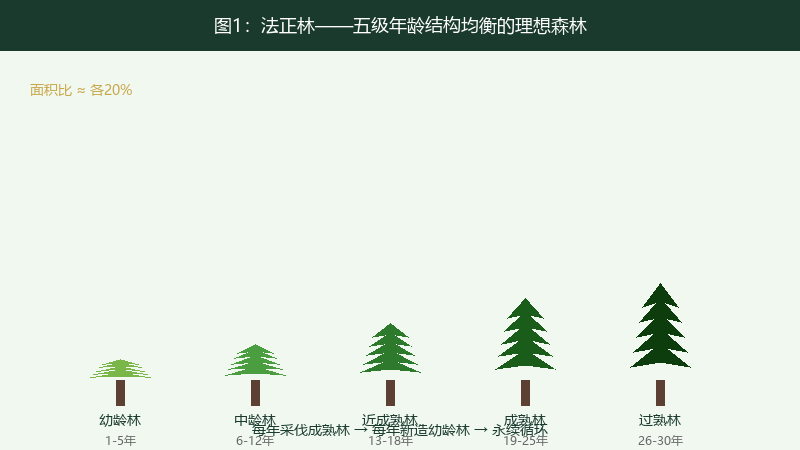
Figure 1 | The normal forest: an ideal forest with a balanced five-class age structure — mature stands harvested every year, young stands established every year, in perpetual cycle
“Having trees of every age matters more than letting every tree live to old age.”
3. The Scientific Design of Harvest Quotas: From Rule of Thumb to the Normal Forest
3.1 The Core Principles of the Harvest Quota
China operates a forest harvest quota system, and many people read it as “the state won’t let me cut.” That is another misunderstanding. The harvest quota is in fact a precise system of scientific calculation, and its core logic runs as follows.
Step one: determine the “final felling age” (rotation age) of the main species. Different species grow at different rates and reach maturity at different ages. Simao pine in Yunnan, for example, has a final felling age of about 25 years; Korean pine in the northeast, about 80 years; and fast-growing, high-yield eucalyptus plantations in south China can be felled at just seven years. This final felling age is the “denominator” in the harvest quota calculation.
Step two: calculate the “theoretical annual harvest.” The formula is very simple: annual harvest = total stand area ÷ final felling age × yield per mu. For example, suppose you manage 100,000 mu of Simao pine with a final felling age of 25 years; the area you can theoretically harvest each year is 100,000 mu ÷ 25 years = 4,000 mu, or no more than 4 percent of the total area per year. This must also take into account the interim output of tending thinnings and differences in yield per mu across site conditions.
Step three: apply the “age-structure adjustment coefficient.” If mature and over-mature stands account for too large a share of the current forest, that means too little was harvested historically, so the harvest quota for the current year should be relaxed appropriately to speed up the pace of renewal. Conversely, if young and middle-aged stands dominate, that means past over-harvesting or too much new planting, so the current year’s quota should be tightened to give the younger stands time to grow.
The elegance of this design is that its goal is not to “restrict harvesting” but to “make harvesting sustainable.” With a scientifically designed harvest rhythm, in a number of years this forest will become a normal forest with a balanced five-class age structure — young, middle-aged, near-mature, mature, and over-mature. At that point there is a steady harvest income every year, while the overall structure of the forest stays healthy throughout.
3.2 A Worked Example: Modeling the Harvest Quota for 100,000 Mu of Simao Pine
Let us demonstrate this process with a concrete numerical model:
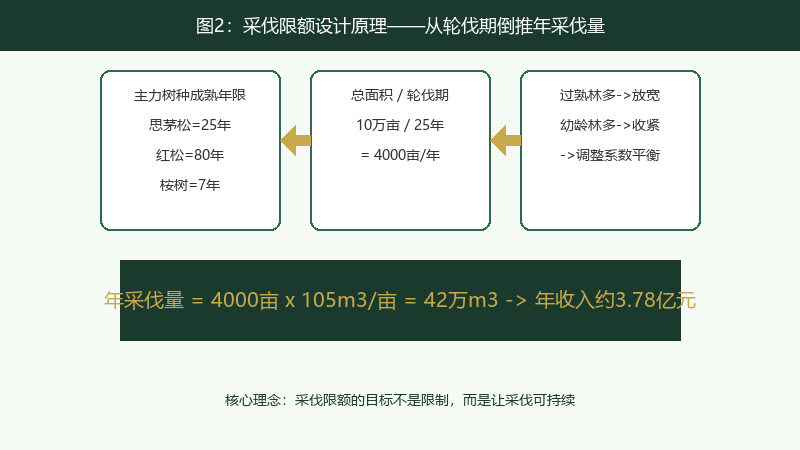
Figure 2 | The logic of harvest quota design: total area divided by rotation age equals annual harvest area, with an age-structure adjustment coefficient
Table: The ideal age structure and management measures for a 100,000-mu normal forest of Simao pine
| Age class | Stand age (years) | Area (10,000 mu) | Share | Volume per mu (m³) | Total volume (10,000 m³) | Management measures |
| Young stand | 1-5 | 2.0 | 20% | 2-15 | 4-30 | Replanting · weeding · fertilizing |
| Middle-aged stand | 6-12 | 2.0 | 20% | 15-45 | 30-90 | First thinning · density control |
| Near-mature stand | 13-18 | 2.0 | 20% | 45-75 | 90-150 | Second thinning · target-tree selection |
| Mature stand | 19-25 | 2.0 | 20% | 75-105 | 150-210 | Final felling · retaining seed trees |
| Over-mature stand | 26-30 | 1.5 | 15% | 105-120 | 158-180 | Shelterwood regeneration · artificial promotion |
| Total | — | 9.5 | 95% | — | 432-660 | 5% reserved as an ecological buffer |
Under this age structure, the mature stand harvested by final felling each year is about 100,000 mu ÷ 25 years = 4,000 mu per year, yielding roughly 4,000 mu × 105 m³ per mu = 420,000 cubic meters of timber. At the current Simao pine price of about RMB 900 per m³, that gives annual timber revenue of about RMB 378 million. At the same time, tending thinnings each year produce small- and medium-diameter timber that can be used as industrial raw material for pulpwood and engineered panels, adding further income.
The key point is that this level of harvesting does not damage the forest’s overall structure. Every year 20,000 mu of young stand is growing, 20,000 mu of middle-aged stand is putting on volume, and 20,000 mu of near-mature stand is accumulating — the 4,000 mu that is cut has simply been “rotated.” At the macro level, growing stock does not fall; it keeps rising, because young and middle-aged stands grow fast. That is the magic of the normal forest: the secret of “cutting more and having more” is that while you harvest, more young trees are growing rapidly.
“Harvesting is not an ending but the beginning of a new round of growth.”
4. The Wisdom of “Stress Growth” in Forests: From Trees to Human Lives
4.1 Forests Need “Disturbance”
I often discuss a question with the forestry experts on my team: is a forest better off the more “comfortable” it is? The answer is no. Nature’s wisdom tells us that moderate “stress” is what activates a forest’s vitality.
From an ecological standpoint, the Intermediate Disturbance Hypothesis is one of the foundational theories of modern ecology. Its central claim is that moderate disturbance — wildfire, windthrow, flooding, harvesting, and the like — can markedly increase biodiversity, while either no disturbance at all or disturbance that is too frequent leads to a decline in diversity.
A vivid example: in the Korean pine forests of the Changbai Mountains, if there is no fire or harvesting for hundreds of years, a thick layer of pine needles builds up on the forest floor, the seeds cannot reach the soil, and natural regeneration stops entirely. A moderate, low-intensity fire, by contrast, clears the needles and weeds from the surface, exposes mineral soil, and greatly raises the germination rate of Korean pine seeds. At the same time, the broadleaf plants that sprout after the fire attract large numbers of herbivores, which in turn attract birds of prey and the predators of those birds… the entire food web has been “rebooted.”
This is why fire-dependent ecosystems in North America, such as giant sequoia and longleaf pine forests, have declined after long-term fire suppression. It is also why the phenomenon in the Greater Khingan Mountains — where forest health declined as fire was suppressed — has prompted academic discussion of “controlled prescribed burning.”
4.2 The “Stress Training” of Plants and Animals
The relationship between plants and animals is far more complex than “one eats, one is eaten.” Moderate mutual stress is precisely what drives coevolution.
Take the African savanna. To defend itself against giraffe browsing, the acacia has evolved an ingenious information system: when a tree is heavily browsed, it releases ethylene gas, an “alarm signal” that drifts on the wind, and nearby acacias that receive it quickly accumulate tannic acid in their leaves (which can damage a herbivore’s liver), making the foliage unpalatable. And the giraffes? They walk upwind, seeking out acacias that have not yet received the “alarm.” This is an arms race that has run for millions of years, and it is exactly this stress that drove the acacia to evolve a more complex chemical defense system and the giraffe to evolve sharper search strategies.
The lesson for us is that forest management should not pursue “zero disturbance.” Moderate harvesting, thinning, and understory cultivation and breeding mimic nature’s “moderate disturbance” — they do not destroy the forest; on the contrary, they make it healthier and more resilient.
“Moderate stress is the source of vitality. So it is with people; so it is with trees.”
5. “Sustainable Management” and “Perpetual Management”: A Philosophical Difference of One Word
In Chinese, “sustainable” and “perpetual” (or “continuous”) are often used interchangeably, but in forestry they are strictly distinguished. That distinction is crucial, because it determines our basic attitude toward the forest.
5.1 The Scientific Meaning of “Sustainable Management”
The international definition of Sustainable Forest Management (SFM) was established at the 1993 Helsinki Ministerial Conference on the Protection of Forests in Europe: “the stewardship and use of forests and forest lands in a way, and at a rate, that maintains their biodiversity, productivity, regeneration capacity, vitality and their potential to fulfil, now and in the future, relevant ecological, economic and social functions, at local, national, and global levels, and that does not cause damage to other ecosystems.”
What this definition stresses is “maintenance” — maintaining productivity, maintaining regeneration capacity, maintaining ecological function. Its core objective is “non-degradation.” In other words, sustainable management is a conserving concept — it asks you not to be worse than you are now.
But conserving is not enough. A forest is not static; it is growing, evolving, interacting with the climate. If we settle for “non-degradation,” we are like a person who settles for “not going backwards” — you have indeed not gotten worse, but you have also missed the chance to get better.
5.2 The Transcendent Meaning of “Perpetual Management”
“Perpetual management” (Perpetual Forest Management / Continuous Cover Forestry) is a more advanced concept. Its goal is not to “maintain the status quo” but to “coevolve with the forest.”
Specifically, perpetual management includes several dimensions that “sustainable management” does not necessarily emphasize:
First, the difference in “time depth.” Sustainable management is usually assessed on the timescale of one management cycle (10-30 years); perpetual management asks us to think from the perspective of “intergenerational equity” — the management decisions of our generation must answer to our children and our grandchildren. If what you do now will, 50 years from now, leave this forest with stronger ecological functions, richer biodiversity, and higher economic value, then you are practicing perpetual management.
Second, the difference in “system complexity.” Sustainable management tends to focus on “maintaining” the growing stock of the main species; perpetual management requires us to attend to the health of the whole ecosystem — understory vegetation, soil microbes, insect diversity, bird habitat, migration corridors for large mammals, and more. A cavity in an old tree that looks “useless” may be home to seven or eight species. Perpetual management is concerned with health at that level.
Third, the difference in the “relationship between subject and object.” Under sustainable management, people are the forest’s “managers”; under perpetual management, people are its “symbiotic partners.” You do not stand outside the forest to “manage” it; you stand within it, “participating” in its life process.
“Sustainable management is doing no harm; perpetual management is coevolution.”
6. AI: Only by Reading the Forest Can We Live in Perpetual Symbiosis with It
What is the greatest challenge for perpetual management? Not capital, not technology, but “reading.” Our human understanding of the forest is far too limited. We can see a trunk’s diameter, a tree’s height, its crown width — but we cannot see how the mycorrhizal networks underground pass information, we cannot understand what the volatile organic compounds plants release are saying, and we cannot feel the daily rhythm of the soil microbial community.
If we cannot read it, we cannot truly “converse”; and without conversation, there can be no symbiosis.
6.1 The “Emotions” of Plants: What Are They Saying?
Modern plant neurobiology has already revealed that although plants have no nervous system, they possess complex systems for sensing and transmitting information.
When a tree suffers drought, its roots release chemical signals that travel through the mycorrhizal network in the soil to neighboring trees, reminding them to “reduce transpiration and conserve water.” The discovery of this “Wood Wide Web” by scientists completely changed our understanding of the forest — a forest is not a group of isolated trees but a single vast, interconnected superorganism.
When a stand is heavily attacked by insects, the damaged trees release volatile organic compounds (VOCs); these gases not only warn neighboring trees of the same species but can also “summon” the pests’ natural enemies — parasitic wasps, predatory birds, and others. This is the plant’s “SOS signal.” Recent research has even found that some plants produce changes in electrical signals when touched, similar to the action potentials of animal neurons — an emerging discipline known as “plant neurobiology.”
6.2 How AI Helps Us “Read” the Forest
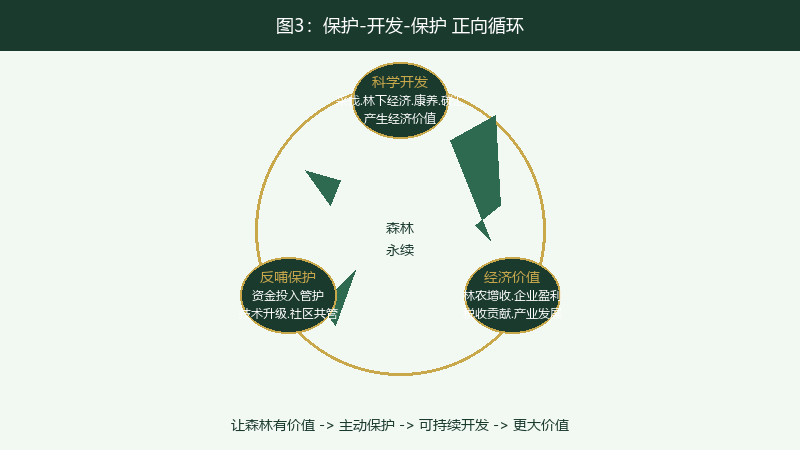
Figure 4 | AI builds a channel of “understanding and dialogue” between people and the forest: a three-tier architecture from sensor data to manager decisions
These plant signals are far too complex for human senses to interpret directly. But AI can. This is one of the important reasons we invested in Luxi Technology’s brain-inspired large model: to use AI to build a “channel of understanding and dialogue” between people and plants, and between people and the forest.
Specifically, AI can do the following things when it comes to “reading the forest”:
First, decoding plant signals. By deploying a sensor network in the forest, we collect real-time multidimensional data — VOC emission spectra, chlorophyll fluorescence, trunk electrical signals, soil moisture and conductivity. AI models translate this “plant language” into information people can understand: “This stand is under mild drought stress” — “This is an early warning signal before an insect outbreak” — “Mycorrhizal network activity in this stand is declining; soil health may be a problem.”
Second, analyzing animal behavior. The animals in a forest are “indicators” of its health. Using acoustic sensors, infrared cameras, and AI visual recognition, we can monitor in real time the species, numbers, range, and migration patterns of wildlife in the forest. When the range of an indicator species (such as the protected animals of China — the Amur tiger, the Chinese desert cat, the golden snub-nosed monkey) suddenly shrinks or shifts, that is a major early warning that the forest ecosystem is in trouble.
Third, an ecosystem digital twin. The entire forest ecosystem — trees, vegetation, animals, microbes, soil, hydrology, climate — is modeled in digital space to form a “digital twin forest.” In this virtual forest we can simulate the long-term consequences of different management measures: “If I carry out a tending thinning at 30 percent intensity in this area, what will bird diversity look like here in ten years?” “If I don’t harvest this over-mature stand this year, how likely is a pine wood nematode outbreak next year?” — AI can give quantified predictions.
6.3 From “Managing the Forest” to “Conversing with the Forest”
The ultimate goal of these technologies is not to let people “control” the forest more precisely but to let people “understand” it more deeply. Only when we can understand what the forest is “saying” — its joy, its anxiety, its warnings — can we move from “manager” to “symbiotic partner.”
This is like the relationship between a parent and a child. If you cannot understand what a baby’s crying means (hungry? tired? sick?), you cannot truly raise him. But once you can read his every signal, you are no longer merely “raising” him; you are “growing up alongside him.” The same is true of a forest.
“Only by reading the forest can we grow perpetually alongside it.”
7. How Forest Resources Sustain Human Society and the Economy
We manage forests not only because the forest needs us but, more importantly, because we need the forest. This is a reality we must face: only when a forest is “useful” to people will it be truly protected.
7.1 The Four Major Ecosystem Services of Forests
The United Nations Millennium Ecosystem Assessment (2005) divides forest ecosystem services into four major categories:
First, provisioning services: timber, fiber, fuel, food, fresh water, medicinal plants, genetic resources, and more. About 1.6 billion people worldwide depend directly on forests for food, medicine, and fuel. The World Health Organization estimates that roughly 80 percent of the world’s population relies to some degree on traditional plant medicines, and the main source of those medicinal plants is the forest ecosystem.
Second, regulating services: climate regulation, water conservation, water purification, flood buffering, soil retention, pollination, and natural pest control. Take “water conservation” alone: China’s forest ecosystems conserve about 580.7 billion cubic meters of water a year, equivalent to 15 percent of the country’s total water resources. If these “invisible” services had to be replaced by engineered means, the cost would be astronomical.
Third, supporting services: soil formation, photosynthesis, nutrient cycling, and the water cycle. These are the “underlying services” that support all other ecosystem services.
Fourth, cultural services: aesthetic and spiritual value, recreation and tourism, scientific research, and environmental education. Forest wellness has become a new growth point for industry in China, with 2.5 billion visits for forest tourism and wellness in 2023.
7.2 The Virtuous Cycle of “Protect — Develop — Protect”
There is a key piece of economic logic here that deserves our reflection: only when a forest is “valuable” to people will they “actively protect” it.
Look at the counterexamples at home and abroad. In sub-Saharan Africa, why do local farmers burn and clear land? Because the forest has “no economic value” for them — it cannot be exchanged for money, for grain, or for their children’s school fees. And in China, after commercial logging of natural forest was halted entirely, illegal logging in some forest areas rose rather than fell — again because the livelihood problem of forest farmers had not been solved.
In Wuping, Fujian, by contrast, local forest farmers developed the understory economy (medicinal herbs under bamboo, honey, forest-raised chickens) and forest tourism, earning a steady income from the forest, and they spontaneously became its guardians. Because now every tree has something to do with their wallet.
This is the virtuous cycle of “protect — develop — protect”: scientific development and use generate economic value from the forest; that economic value supplies the funding and the motivation for protection; and protection in turn keeps development sustainable. Once this cycle is established, external “regulation” and “subsidies” are no longer needed — market forces drive the process on their own.
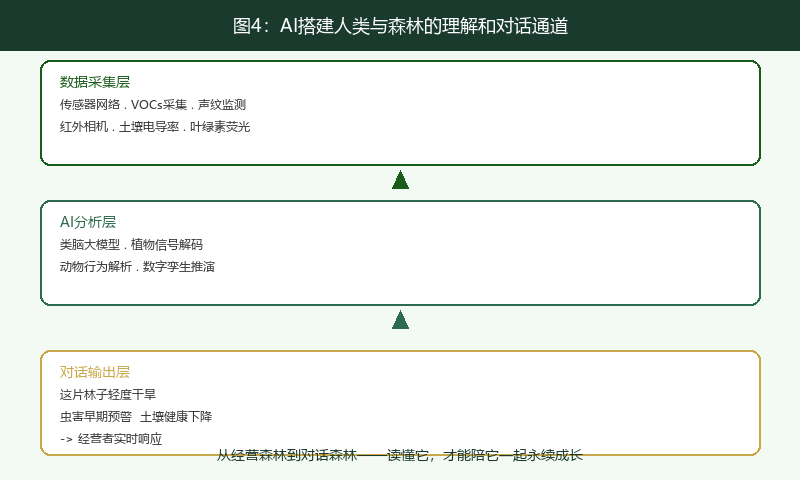
Figure 3 | The “protect — develop — protect” virtuous cycle: a forest with value is protected voluntarily, and sustainable development creates still greater value
“Making a forest valuable is the best way to protect it.”
8. From Sustainable Management to Perpetual Management: My Next-Level Thinking
Building on all of the above, I want to propose a more advanced framework — the “five-stage model of perpetual forest management” — as a reference path for operators who want to move from sustainable management toward perpetual management.
8.1 The Five Stages of Perpetual Management
Stage one: resource utilization. The goal is scientific use of forest resources, ensuring that the harvest does not exceed growth. This is the foundation, and it is what most forest areas in China are doing today.
Stage two: ecological optimization. While maintaining resource output, actively optimize stand structure, enhance biodiversity, and improve soil health. Adopt a “target-tree management system”: not “cut whichever tree you can,” but “keep whichever tree has the most promise.”
Stage three: value discovery. Beyond harvesting timber, deeply develop diverse values — the understory economy, forest wellness, carbon sink trading, biomedicine, and more. This is the “five major business lines” and “three-dimensional, multiple income streams” that we have stressed repeatedly in earlier articles.
Stage four: community co-building. A forest is not only the operator’s asset but also the home of the surrounding community. Through linking-farmers-benefiting-farmers mechanisms and community co-management, forest farmers and operators form a community of shared interests, which solves the “monitoring cost” problem — hundreds of millions of forest farmers are hundreds of millions of guardians, and their eyes are more timely and more effective than any satellite.
Stage five: intergenerational equity. This is the highest level of perpetual management. The management decisions of our generation must answer not only to today’s shareholders and forest farmers but also to future generations. Concretely, we must ensure that 50 years from now this forest’s growing stock, biodiversity, and ecosystem services are no lower than they are today, and that 100 years from now it is still a normal forest with all five age classes present.
8.2 The Vision of a Global Forest Civilization
If we widen the lens to the global level, I want to propose a grander vision: a “global forest civilization.”
The core idea of this vision is this: when every country, every community, and every individual realizes that “the forest is our shared wealth, not someone else’s burden,” forest protection will shift from a “moral demand” to a “matter of interest.” This runs in the same vein as the “Forest Coin” system I proposed in F10: the essence of the Forest Coin is to let the ecological value of the forest be priced by the financial system, subscribed by investors worldwide, and included in everyone’s asset allocation. Then “protecting the forest” is no longer a slogan but a rational investment decision.
“The essence of forest civilization is to make every person realize: I am within the forest, and the forest is within me.”
Conclusion: Growing Perpetually, Together with the Forest
Having written this far, I want to close the article with a story.
In Finland there is a tradition called the “Grandfather’s Tree.” When a child is born, the family plants a patch of trees in their own forest; those trees grow as the child grows up, comes of age, and grows old, and they finally reach maturity in the time of his grandchildren or great-grandchildren. That patch of trees is called “the grandchildren’s wealth.”
This is the spiritual core of perpetual forest management: everything we do today is planting a patch of “the grandchildren’s wealth” for future generations. And that “planting” is not passive “protection” but active “management” — through scientific harvesting and regeneration, careful stand regulation, and intelligent ecological monitoring, so that the forest keeps its “youthful vitality.”
What we must do is not leave later generations a “closed museum” but leave them an “open, living, breathing” forest organism.
Because we know this well: true protection is not to make the forest stop forever at a single moment, but to let it grow forever. True guardianship is not to stand outside the forest, but to walk into it. True perpetuity is not static “preservation,” but dynamic “symbiosis.”
Growing perpetually, together with the forest.
────────────────────────────────────
Next up: F07 Using Policy-Based Finance to Leverage Circular Forestry Investment — seemingly unprofitable, yet able to earn richly
────────────────────────────────────
— Foreststellar · Perpetual Forest Management Series —