Using Policy-Based Finance to Leverage Circular Forestry Investment
F07 Using Policy-Based Finance to Leverage Circular Forestry Investment
It looks unprofitable — in fact it can be highly profitable
When most people hear the word “forestry,” their first reaction is: it doesn’t make money. Add “National Reserve Forest” and the reaction gets even more direct: that’s just a public-benefit project living on subsidies — how could it possibly be profitable?
This is a profound misunderstanding. In this article I want to dismantle it completely: by using policy-based finance to leverage circular forestry investment, a project that looks unprofitable can in fact be highly profitable.
【Policy-based finance: a low-interest lever built for forestry】
China’s financial support for forestry is, among all industries I have observed, the strongest — without exception. Consider a few key policies:
National Reserve Forest project loans: provided by China Development Bank and the Agricultural Development Bank of China, with terms of up to 30 years (including an 8-year grace period) and interest rates substantially below LPR. What does that mean? You borrow a sum of money and, for the first eight years, repay only interest — principal repayment does not begin until year nine. For a long-cycle industry like forestry, this is a financial product almost tailor-made for you.
The central bank’s policy on financial support for rural revitalization: in April 2022 the People’s Bank of China issued its “Opinions on Doing Well the Key Work of Financial Support for Comprehensively Advancing Rural Revitalization,” explicitly requiring stronger financial support for National Reserve Forest development. The 2024 No. 1 Central Document once again emphasized the role of policy-based finance — the Agricultural Development Bank of China, China Development Bank and others — in rural revitalization.
Central government forestry reform and development funds: direct subsidies for afforestation, forest tending, and the cultivation of improved tree varieties. There is also dedicated funding for understory economy demonstration bases and for the extension and demonstration of forestry technology.
Stack these policies together and an astonishing conclusion emerges: in forestry — especially National Reserve Forest projects — you are in effect using other people’s money (low-interest policy loans) to plant other people’s trees (the national strategic reserve), while still earning a substantial profit yourself. This is one of the most elegant policy arbitrages I have ever seen.
【The compounding magic of IRR】
Let us use a concrete model to see how high policy-based finance plus diversified operations can push the IRR (Internal Rate of Return) of a forestry project that looks ordinary, or even loss-making.
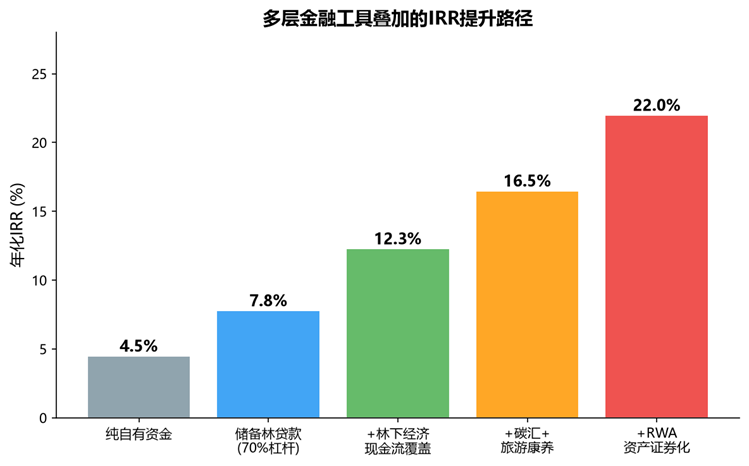
Layer one: pure equity investment. Assume a 100,000-mu National Reserve Forest project with total investment of RMB 100 million (RMB 1,000 per mu), a 30-year cycle, and timber sales as the main revenue. Without leverage, the annualized IRR is roughly 4%–5% — genuinely not high, comparable to a bank wealth-management product.
Layer two: introducing policy loans. At the 70% loan ratio typical of National Reserve Forest projects, you need to fund only RMB 30 million yourself; the remaining RMB 70 million comes from a policy bank at roughly 3.5% interest (far below market rates). Your ROE (Return on Equity) now jumps from 4.5% to 7%–8% — because you are using capital that costs 3.5% to generate a 4.5% return, and the entire 1% spread accrues to your own equity. That is the magic of leverage — and of low-cost leverage in particular.
Layer three: adding the understory economy. In earlier articles we argued repeatedly that the understory economy, through a cocktail model, can generate cash flow within 24 months. Assume understory revenue of RMB 500 per mu per year (our baseline standard); on 100,000 mu that is RMB 50 million in annual revenue. After costs, annual net profit is roughly RMB 10 million. This cash flow can service loan interest and even prepay part of the principal. The project IRR can then rise further, to 12%–13%.
Layer four: adding carbon sinks and tourism/health retreats. Carbon sinks are still modest in scale (only RMB 10–30 per mu per year), but they cost almost nothing. Well-executed tourism and health retreats offer considerable spatial revenue and do not consume forest resources. Stacking the two lifts IRR by another two notches, to 16%–17%.
Layer five: asset securitization (RWA/REITs). Once the first four layers are solidly in place, this forest becomes a high-quality asset with stable, predictable cash flow. At that point you can achieve partial or even full exit through asset securitization (issuing REITs or RWA products), recovering your initial investment while retaining operational management rights and continuing to collect management fees. IRR jumps straight above 20%.
So you see: from 4.5% to 22% is not wishful thinking — it comes from layering financial instruments and operating strategies one on top of another. This is precisely the logic I mean by “seemingly unprofitable, in fact highly profitable.”
【The flywheel of circular investment】
What is more powerful still is that this model is not a one-off.
Suppose the first 100,000-mu project succeeds; you recover your initial investment through securitization and hold capital again. You use that capital to launch a second 100,000-mu project, repeating the same stacking process. Then a third, a fourth…
With every cycle, your management experience accumulates, your technology platform iterates, your brand credibility strengthens, financial institutions raise your credit lines, and forest farmers’ trust in you deepens. This is the classic flywheel effect — spinning faster and more effortlessly the longer it turns.
Zhongsen Ecology’s goal is to hold and manage 100 million mu of forest resources by 2028. That sounds ambitious, but broken down into the flywheel model of circular investment it is not out of reach. Because we are not buying mu by mu with our own money — we are rolling forward ten thousand mu at a time using the leverage of policy-based finance, the cash flow of diversified operations, and the exit mechanism of asset securitization.
【Not arbitrage, but value creation】
At this point I sense some readers may say: isn’t this just getting something for nothing?
No. Policy-based finance supports forestry not because the state is naive, but because forestry genuinely generates enormous positive externalities — carbon sequestration and oxygen release, water conservation, biodiversity protection, support for rural revitalization. These social values cannot be priced automatically by the market, so the state uses policy-based finance to correct the market failure.
Our role is to convert these undervalued social values — through professional management and financial innovation — into market value that gives investors a reasonable return. This is not arbitrage; it is value discovery and value creation.
The profit we earn is, in essence, a return on our professional capability and compensation for the risk we bear across a very long cycle.
【Conclusion】
Policy-based finance is the greatest lever in forestry investment and operation — but leverage is not an end in itself. Its purpose is to amplify your operating capability: if you have what it takes to manage a forest well, leverage multiplies your returns; if you lack operating capability, leverage only accelerates your failure.
So everything comes back to fundamentals: plant the trees well, manage the forest well, and make every business line solid. Finance is only a tool; the real economy is the foundation.
In the next chapter we turn to a topic that seems highly technical but in fact concerns the immediate interests of every forestry practitioner — how full-scope FSC certification can carry Chinese forest products into global markets.