Short-Long Combination: Spatial and Ecological Short-Term Returns

F04 The “Short-Long Combination” Forest Resource Development Model (Part Four: Spatial and Ecological Short-Term Returns)
The scope this part appears to cover is small, but spatial income explores the relationship between forest space and people, expressed mainly through forest tourism and forest wellness; ecological income explores the value of the forest’s influence on people’s lives in the course of urbanization, expressed mainly through carbon sinks.
But when we dig deeper, there is still much here worth exploring in terms of innovation — carbon sinks in particular. Under the existing methodologies, forestry carbon sinks have in practice become almost a “false proposition” that cannot be carried out. In this chapter we will also ask where future methodologies should be corrected.

Spatial Short-Term Returns
Why do I argue that the spatial economy should be separated out from the understory economy? Because the understory economy studies the symbiosis between plants (and animals) and plants, while the spatial economy studies the relationship between people and the forest. Their internal logic and methodology are different.
The most common forms of forest spatial income are simply relationships between people and the forest along two dimensions, “mind” and “body”: the former is leisure and experiential tourism, the latter health and wellness retreats.
There is also one form of spatial income that few have attempted: using forest-edge land adjoining the urban development boundary to anchor urban development returns.
Let us start with leisure and experiential tourism and wellness. As a rule they are not short-cycle returns; their payback period in particular is extremely long (within our own organization they are classified as prohibited investments). When you acquire a tract of forest land and want to develop tourism and wellness, you must first apply, in line with the plan, to occupy forest land (converting it to construction land), then build infrastructure, then buildings and facilities. That whole sequence consumes most of your capital and several years. Once you open, you discover that because it is not an essential demand for people, it is hard to recover your capital within a few years. Unfinished or chronically loss-making projects of this kind are everywhere.
There are of course short-cycle business lines that do not depend on heavy-asset construction: forest study programs (nature education), forest therapy (hiking, scent-based forest bathing, yoga, meditation), RV camping, forest events (music festivals, for example) and so on. With a little simple infrastructure they can be launched. The drawback is that they cannot be scaled up, and they rarely build long-term, sustained repeat business. They suit a decorative, supplementary role in forestry, or small, boutique operators running a small business built around a personal interest.
Some rather special business lines may become feasible in the future, or if policy makes a breakthrough.
Forest hunting, for example, is quite popular in some countries, has strong repeat-purchase stickiness, and combined with sales of peripheral gear can generate considerable income. But it depends on justification under animal protection policy and on a policy breakthrough.
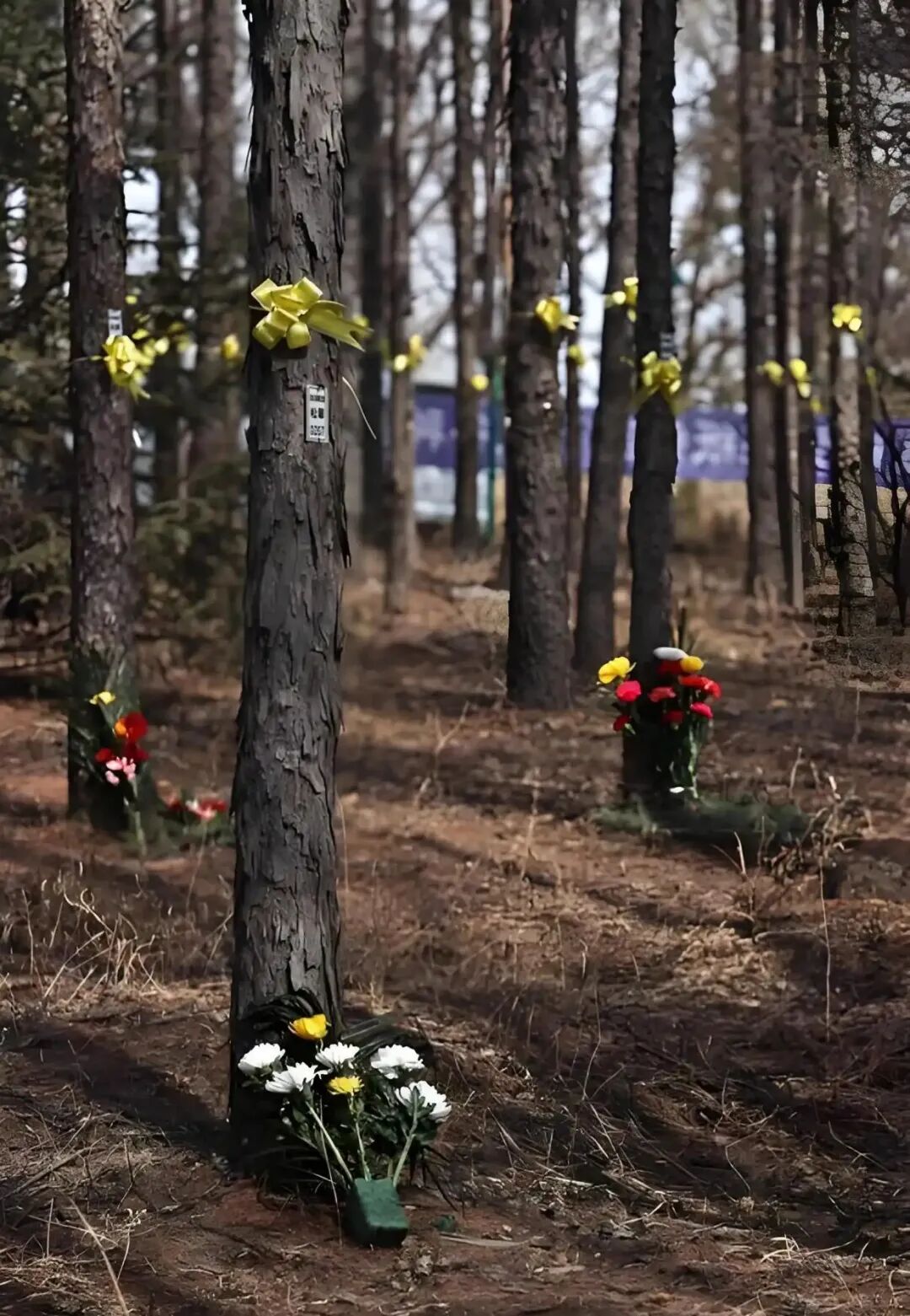
Then there is the forest cemetery: after a person dies, the ashes are ecologically scattered and merged with long-rotation living trees, so that the soul of the departed merges with the life of the tree; memorial rites are conducted in an eco-friendly way, with no fire and no offerings. As the post-2000 generation enters mainstream society, the younger generation’s attitudes may become more accepting, and a policy pilot could be sought from the ethnic and religious affairs authorities.
These can all generate considerable income and long-term, sustainable repeat business — but they must wait for shifts in conventional attitudes and for policy breakthroughs.

【Linkage income from forest-edge land on the urban development boundary】 This stream of potential income is both spatial income and ecological income. I say “potential” because no one is yet paying forest holders for it.
We have all heard of sea-view or mountain-view apartments (forest-view homes): their developments or units sell for more than others.
A typical example is Hong Kong’s Mid-Levels and the surrounding estates with mountain views.

Another is the famous Yunding Zhizun development in Xiamen on the mainland.
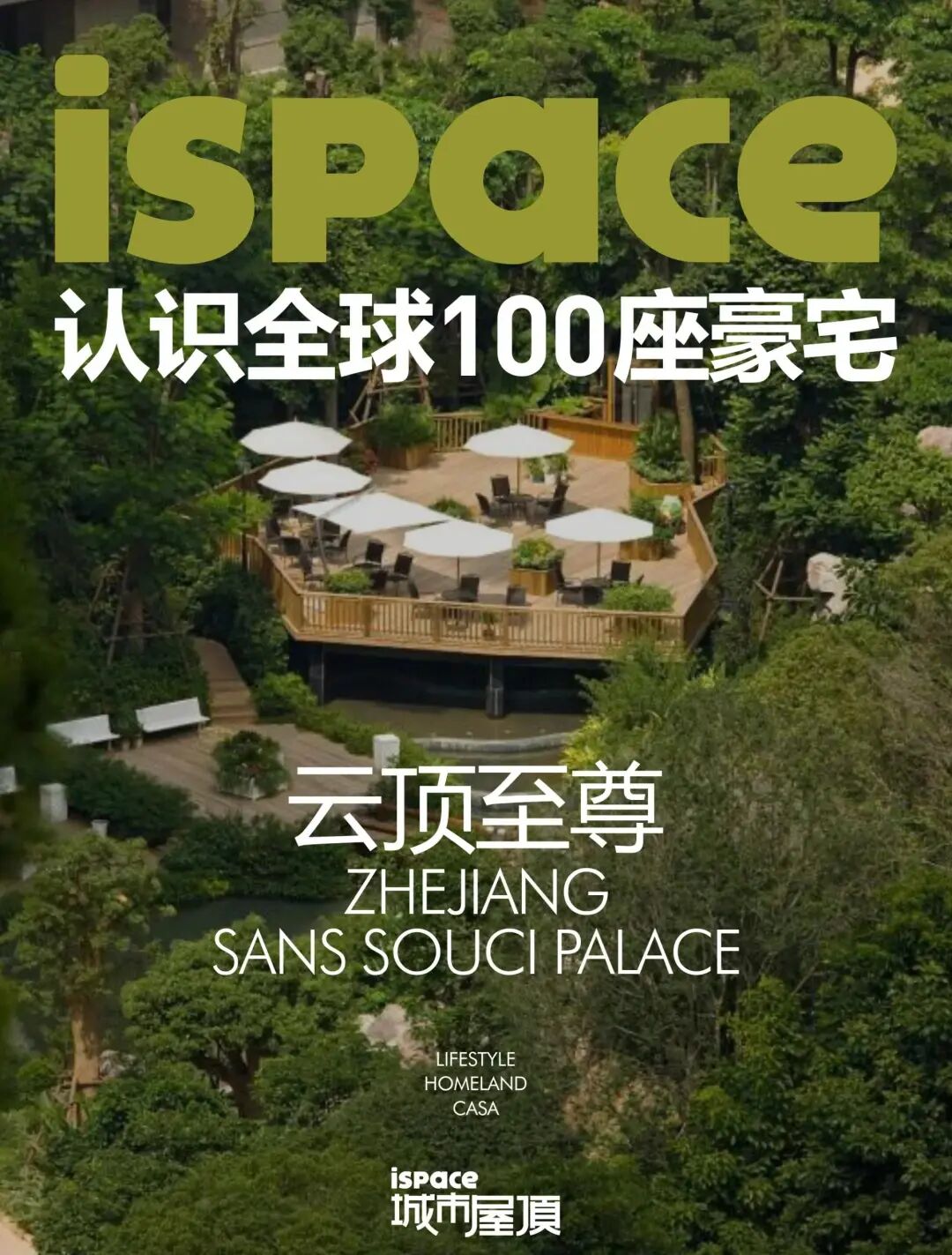
Yunding Zhizun is more interesting still: the estate takes in the entire hill behind it, and a passage leads directly to that back hill, so residents can go into the forest for leisure every day.
Without exception, the developers of these estates earned higher appreciation returns than ordinary developments.
In the Yunding Zhizun case, one assumes the developer did pay the corresponding consideration for use of the forest; but most so-called “mountain-view homes” pay nothing — meaning the forest holder gains nothing from the appreciation of the real estate.
So the competent forestry authorities could very well drive policy-mechanism innovation, letting forest-edge land adjoining urban development zones share a little of the appreciation returns from front-line mountain-view projects — for example, by determining the appreciation through a comparison of housing prices in the same area, then collecting a small ecological or spatial use fee, akin to a resource tax, to subsidize the management of that tract of forest land. Forest land holders can likewise open forest space to these communities’ residents on a moderate basis, achieving a win-win.
Exploring a Breakthrough in Forest Ecological Income
Apart from the attempt discussed above to anchor benefit-sharing with the beneficiaries of urban development, the main form of forest ecological income is the forestry carbon sink that has become so popular in recent years.
Unfortunately, under the current methodological framework, neither the CCER mechanism nor the VCS mechanism can get around the “additionality argument.”
The “additionality argument” for a forestry carbon sink project is the key step that proves the carbon sink the project generates would not occur without external support (such as carbon sink income); at its core it verifies that these carbon sinks are “additional” rather than the result of natural growth or conventional management. This argument is the precondition for a project to obtain China Certified Emission Reduction (CCER) or VCS eligibility and enter carbon market trading.
Some readers may not have followed that. Put simply: if a forest has other development and operating income, it cannot earn carbon sink income. We can understand carbon sinks as a form of public-benefit compensatory income — because you planted the forest and sequestered carbon but have no other income, I compensate you with carbon sink income.
Now let us sort out which forest lands cannot, or are not suited to, develop carbon sink income.
-
Natural forests are all excluded. Put simply, Heaven grew them into forest on its own; that is not a human contribution.
-
Planted forests that have other income are all unsuited to carbon sink development, because carbon sink income is in fact very low (take the fast-growing plantations of the south, which have strong carbon sequestration capacity: one mu of forest land sequesters 0.1-0.3 tonnes of carbon a year, and CCER currently trades domestically at under RMB 100 per tonne — that is, each mu of forest generates RMB 10-30 of carbon sink income a year), and the price is that you can no longer hold other income. The conclusion speaks for itself.
So which forest lands can still be used to develop carbon sink income?
First, three categories of forest land are exempt from the additionality argument.
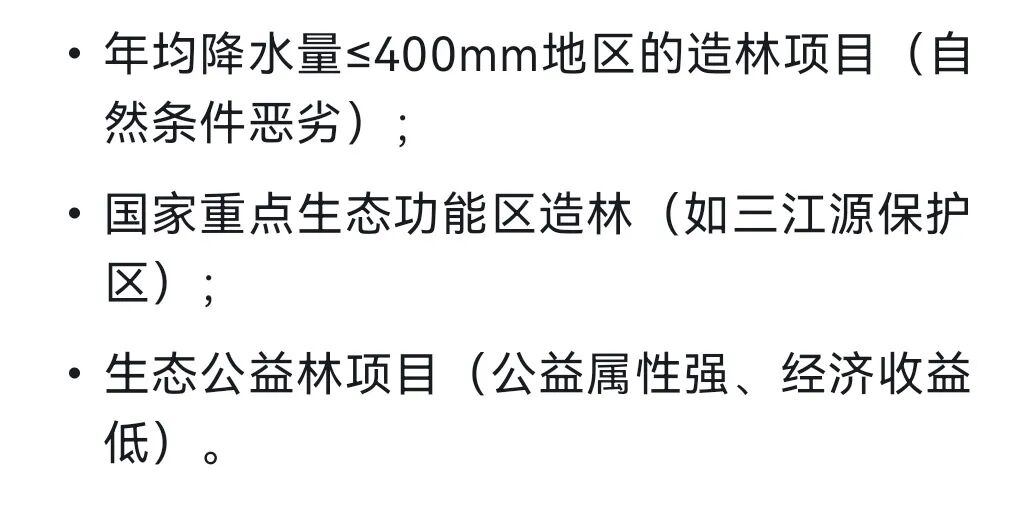
Among them, public-benefit forest projects: in my personal view only national-level public-benefit forest projects are suitable for carbon sink development, because for public-benefit forests below the national level policy has already opened the door to moderate understory economy development, so they too are unsuited to carbon sinks.
The three categories of forest land above still have an opportunity to develop carbon sink income — but one rigid condition must be noted: they must be new plantations established after 2012 (that is, the second commitment period of the Doha conference).
Taken together, these conditions mean that few planted forests in China today are suitable for carbon sink development. So under the existing methodological and mechanism framework, forestry carbon sinks are on the whole a not-quite-viable income path; the revised forest (afforestation and management) carbon sink methodology newly released last year still made no breakthrough here.
Let us explore together where a future breakthrough might lie. The additionality argument is essentially meant to show that this forest’s carbon sequestration (or part of it) is a net increment — in short, that even if I use this forest to earn income from other development, part of its carbon sequestration is still a net increment. From the standpoint of argument, then, the argument can succeed.
A very important means here is achieving full-life-cycle carbon footprint traceability and measurement.
Take a forest that develops carbon sinks and also runs forest tourism. The current argument would hold that people entering the forest cause carbon emissions (leakage) and you earn money from that too, so the argument cannot pass. But think from another angle: do those people who enter the forest and emit carbon stop emitting when they stay at home? As long as a person breathes, they emit carbon. So should such emissions be counted as a deduction? What is true of people is true of equipment and machinery, and of scenario-based business as well. Only when all essential emissions are traced scientifically and precisely, and a forestry project still shows net carbon sequestration after other income is earned and the non-essential emissions generated by those other businesses are deducted, can forestry carbon sinks truly become part of the forest’s fixed income.