Short-Long Combination: Canopy Business Lines
F04 The “Short-Long Combination” Forest Resource Development Model (Part One: Canopy Business Lines)
From this chapter on, we return to concrete industry business lines. This is the foundation of forest assetization as a business. Forestry assetization without real industry behind it is a bubble — water without a source.
In the first chapter we discussed how forestry is an enormous industry worth RMB 100 trillion. Yet this enormous industry seems to produce far fewer operating companies than other sectors, and industry giants are rarer still. The international forestry giants we can find, even with limited information, are almost all built around papermaking — Brazil’s Suzano, Indonesia’s Asia Pulp & Paper (APP), and so on. Companies genuinely engaged in the integrated development and operation of forest resources are almost nonexistent.
As for why, I believe two factors are at work.
First, a forest is made up mainly of trees, and for most timber the growing cycle is a long-period output compared with other industries. Small-diameter fast-growing poplar, for example, needs at least three or four years to reach merchantable size; eucalyptus and rubber trees take five or six; and common high-quality timber plantations generally need decades — some are aimed at a full century. No other industry would accept an input-output cycle like that. So if capital is capital, why would anyone take on annual financing costs and unpredictable market and policy risks to invest in an industry with such a long cycle?
Second, as earlier chapters have said, a forest is a scene of multiple uses, and different organisms involve different development and utilization technologies. It is very hard for one company to span so many fields and use every last part of a biodiverse forest. But single-use utilization not only wastes forest resources — it also struggles to turn a profit from a single conversion.
So, from this chapter on, we will explore the forest’s “short-long combination” development model and its “all-things conversion and utilization” model, in order to break through the two problems described above.

As the name suggests, the “short-long combination” nests business lines with “under five year” short-to-medium conversion cycles on top of forestry’s traditional “five year and above” long-cycle cultivation and conversion.
First, then, let us examine which of forestry’s five major income directions can deliver short-cycle returns.
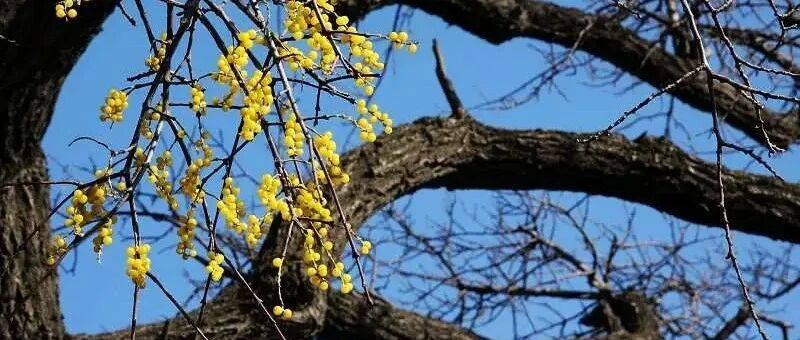
One: canopy harvesting. Short-cycle canopy harvesting normally comes with a precondition — it is based on an established forest stand, because the canopy depends on the trees themselves; with no trees, there is no canopy. For fruit trees that have already reached timber size, or for dual-purpose fruit-and-timber trees (such as Korean pine in the northeast), the annual fruit harvest is unambiguously short-cycle.
But there is another kind of canopy harvesting business that can already generate conversion output during the tending of young and middle-aged stands.
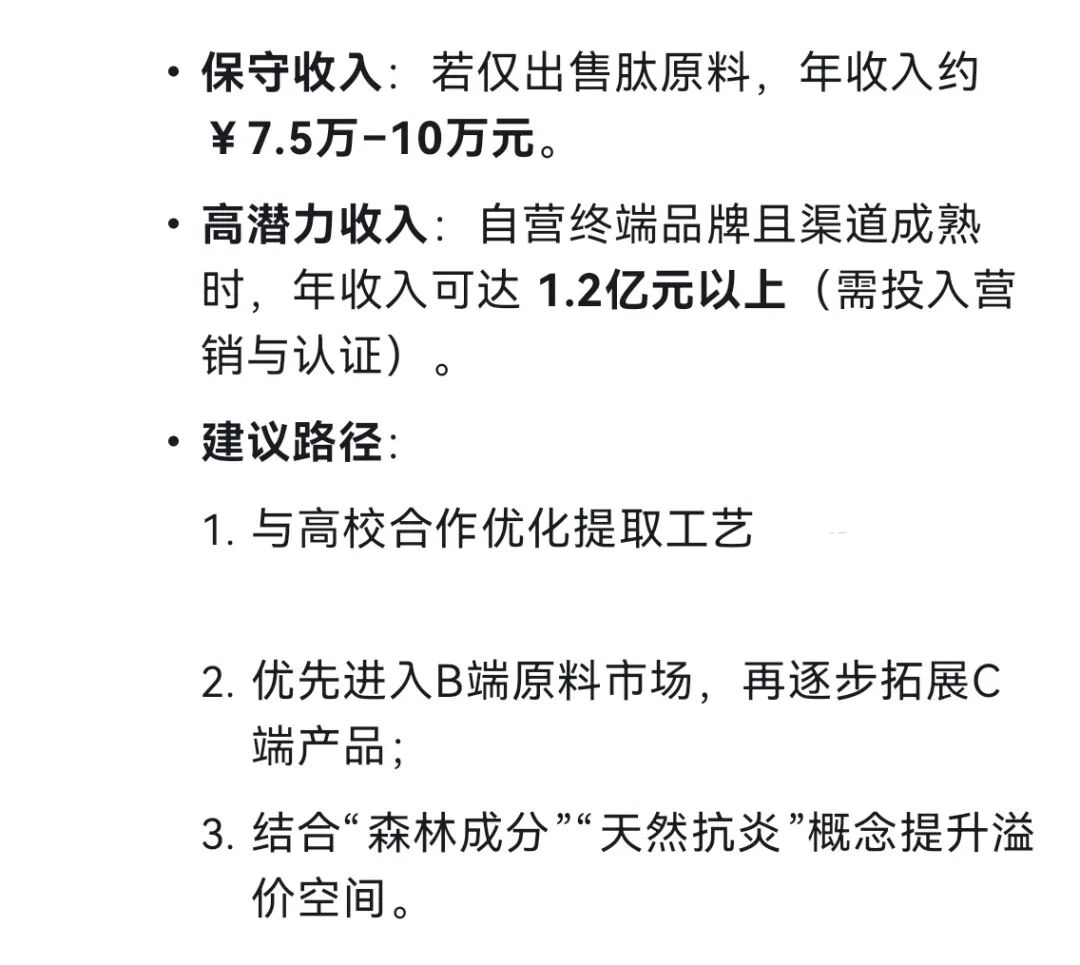
Leaves are a valuable biological asset rich in natural active compounds. Forest tending every year yields large quantities of leaves, and most are treated as waste. Through extraction they can be converted into many products far more valuable than ordinary forest fruit. Biologically speaking, leaves are a tree’s main photosynthesis interface, so the compounds in leaves are generally associated with antioxidant and anti-inflammatory activity. The pine needle peptide products we are developing, for example, are converted into anti-inflammatory products for the skin.

Let us take 100 mu of Chinese pine as an example and see what income those 100 mu can generate by collecting pine needles every year.
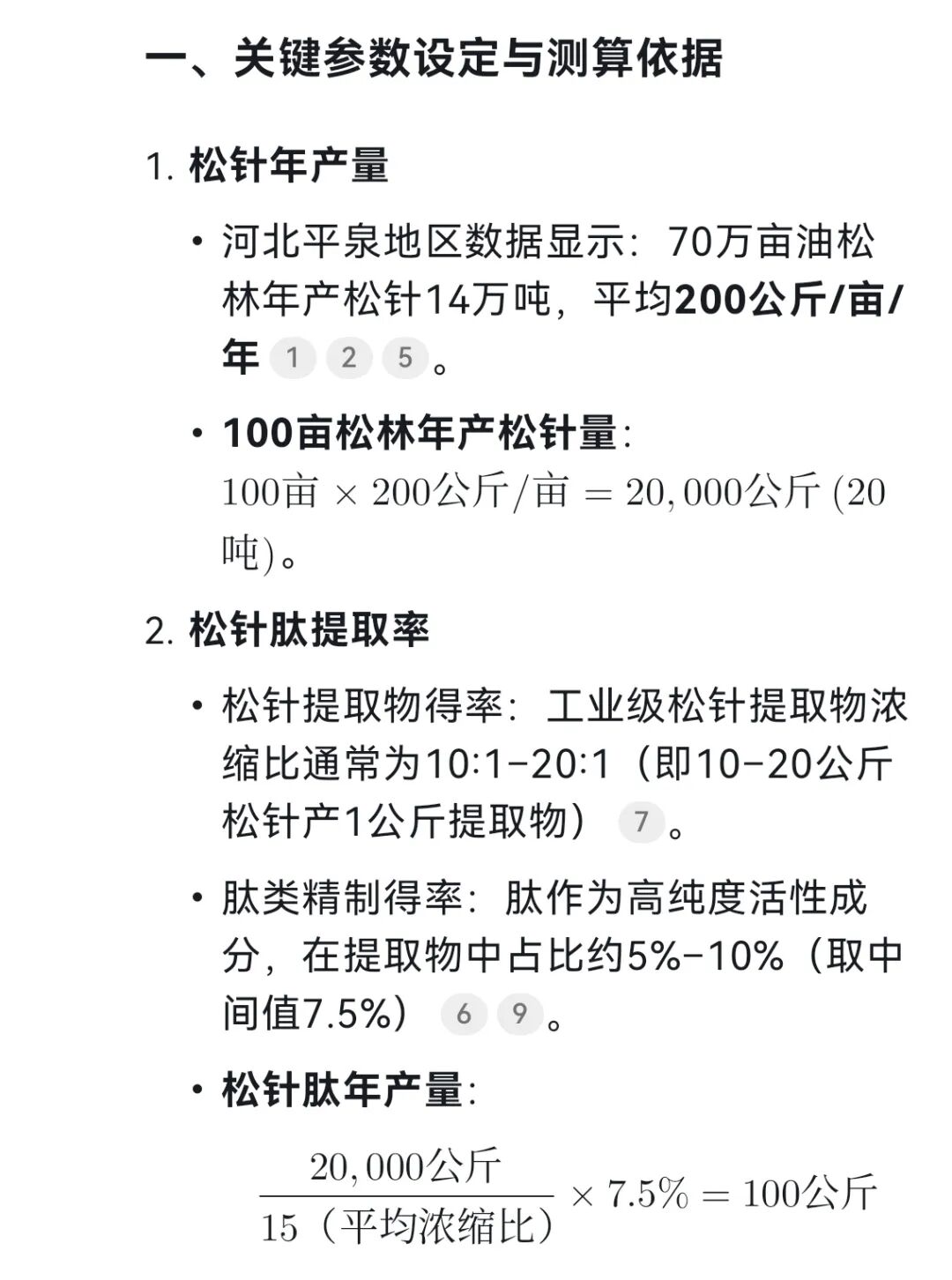
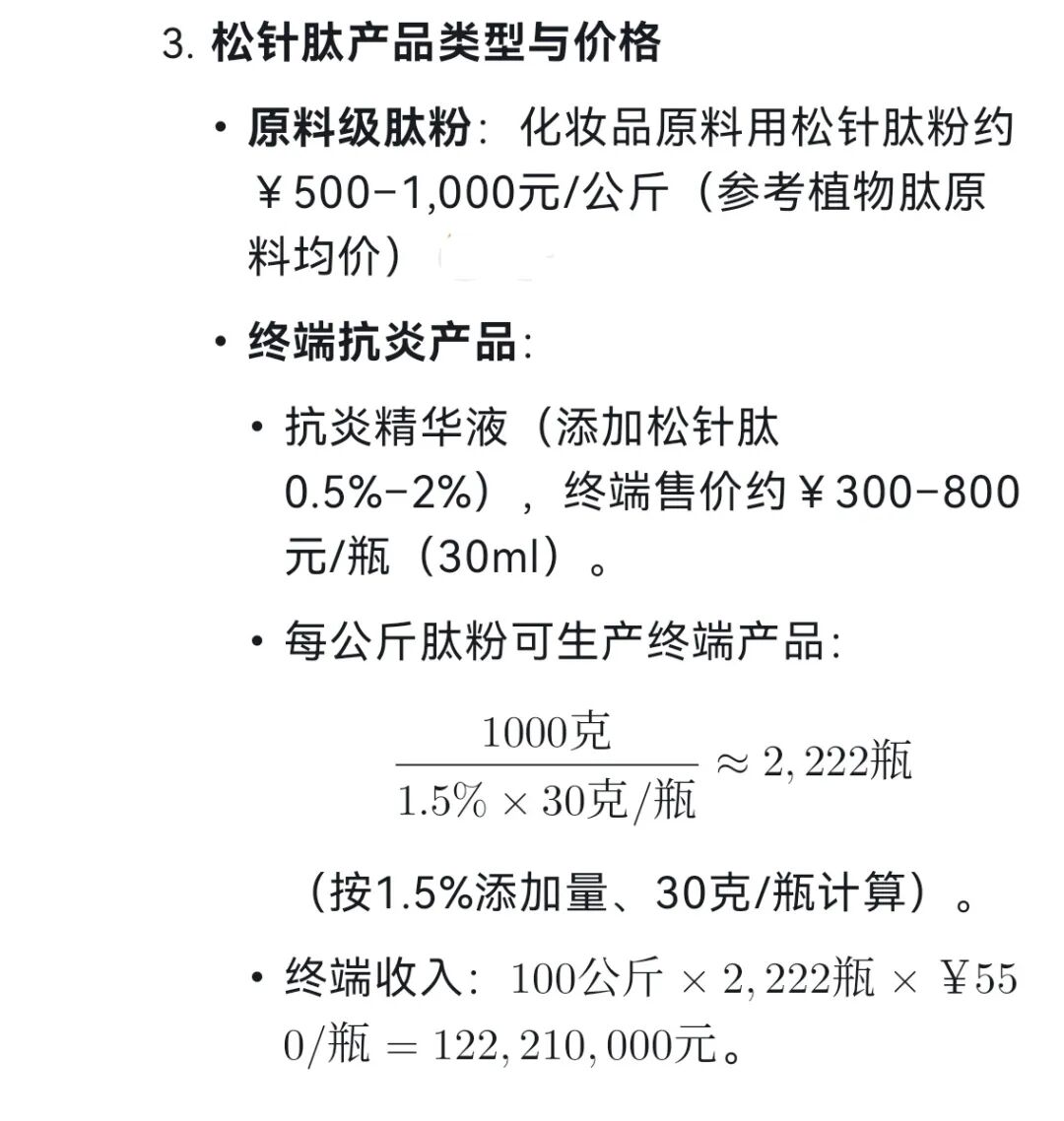
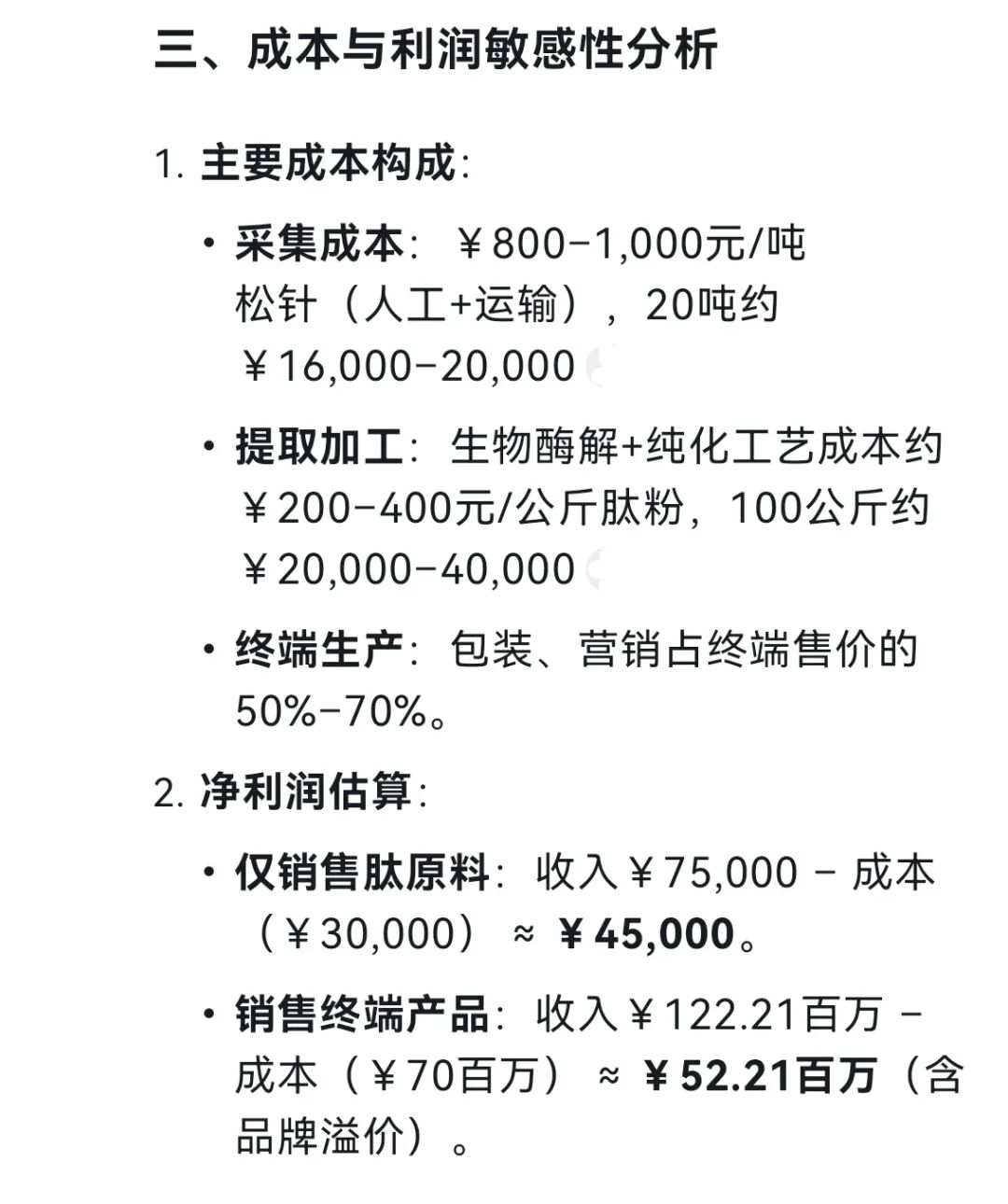
There is another, rather special canopy short-cycle business line: plant and animal parasitism.
One example is a plant used to treat soreness and weakness in the lower back and knees — northern mistletoe. It parasitizes the branches and trunks of trees such as birch (Betula), oak (Quercus), elm (Ulmus), apple, and plum (Prunus), and reaches full growth in a single year.
Of course, long-term parasitism damages the host plant. But with balanced management, it may well be a short-term companion business line worth exploring.
In summary, a canopy short-cycle business line generally means using the non-timber parts of trees for biological utilization while the stand is young or middle-aged, or mature but not yet at final felling. With proper planning and management, it can generate continuous income throughout the growth period when the trees are not yet merchantable and cannot otherwise produce value.
In the next section we will look at whether the main timber itself can generate short-term returns, and at the understory scene that everyone values so highly — the understory scene in particular.