The Minimal (Quantum) Division of Forest Assets
The Minimal (Quantum) Division of Forest Assets — Solving Liquidity So Every Tree Can Be Traded
Original article by Foreststellar · Xu Li
In the previous chapter, F01, I put forward a central thesis: the forest is the greatest financial asset the universe has given humanity — 20% annualized returns, five income streams stacked together, a natural hedge against inflation, and a globally recognized asset. Yet an awkward reality follows it everywhere: an asset this good is not recognized by banks, not invested in by capital, and not circulated by the market. Why? The answer is one word: liquidity.
A single forest easily runs to tens of thousands of mu; each mu absorbs several thousand to over ten thousand yuan of investment; the growth cycle stretches from 25 to 60 years. Without an effective mechanism to break it down into small-denomination, standardized, tradable asset units, it can only ever remain one bulk piece of real estate — locked deep in the mountains, completely cut off from the financial world. This chapter explores the key that unlocks this predicament: quantum division of forest assets.
I. The Liquidity Predicament: A Trillion-Yuan Asset Locked Down by “Big Agriculture” Thinking
To understand why forest assets lack liquidity, we must first understand a deeper question: why is forestry management worldwide still trapped inside the framework of traditional agricultural property rights?
This is not a technical problem but a problem of paradigm. Since the Industrial Revolution, our understanding of “land” has been shaped entirely by agriculture: land is valuable for the crops it can grow, and crops ripen once a year — you must harvest every year, or there is no value. Within this mindset, forest land = land, trees = crops, and forestry = a branch of big agriculture.
This paradigm has produced three serious consequences:
First, a misaligned valuation system. When banks and financial institutions value forest land, they follow the framework used for farmland — assessing only the land’s “current market price” while remaining entirely blind to the biological growth of the forest. A single masson pine can grow to 15 cubic meters of timber in 25 years: value creation that happens every year and can be precisely measured. Yet in traditional farmland valuation, this “future value” is crudely discounted, or even written down to zero.
Second, difficulty in mortgage financing. The core logic of bank credit is this: can you give me collateral that can be turned into cash quickly? Farmland cannot — because it cannot be divided, cannot be standardized, and cannot be listed for trading on an exchange. Forest land falls into the same category. The result: trillions in forest assets worldwide appear on bank balance sheets as “non-mortgageable” — the equivalent of “dead assets.”
Third, a towering investment threshold. Under traditional thinking, to invest in a forest you had to be a “forestry developer” — you had to buy the entire tract, build a professional silviculture team, and endure 25 years without significant cash flow. That threshold shut out 99.9% of potential investors. The financial market is the exact opposite by nature — its very reason for existing is to let the “small fish” take part in the “open sea.”
While agricultural thinking rules forestry, a forest is merely an inefficient “land + crops” asset. Only when financial thinking takes over forestry does the forest reveal its true face: a super biological asset that can be precisely divided, priced along multiple dimensions, and widely traded.
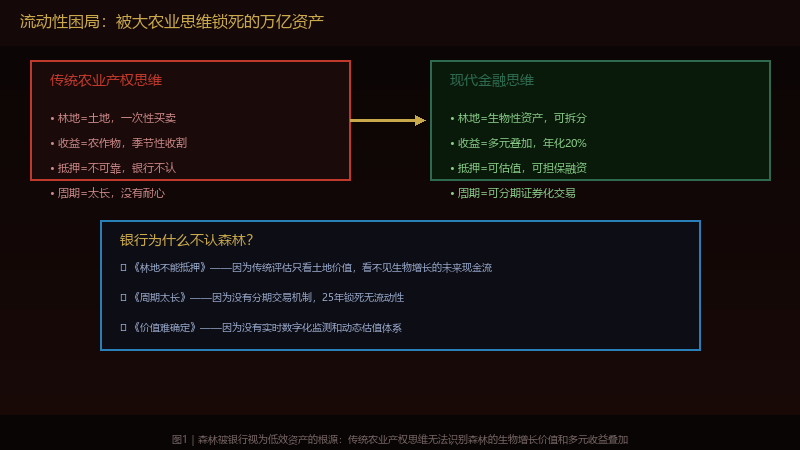
Figure 1|The root of why banks see forests as “inefficient assets”: traditional agricultural property-rights thinking cannot recognize the forest’s biological growth value or its stacked, diversified income
II. Setting the Record Straight on “Quantum”: Not Mysticism, but the Science of Precise Division
Before laying out the technical solution, I must first make an important clarification — about the word “quantum.”
In recent years the concept of “quantum” has been badly abused in society. Quantum combs, quantum insoles, quantum water bottles, quantum speed-reading… these absurd commercial stunts not only have nothing to do with real quantum science; they have gravely polluted a rigorous scientific concept. When I use the word “quantization” here, I mean its original sense in physics: “the smallest indivisible unit of matter or energy.”
In the context of forest assets, “quantization” has a very simple and clear meaning: dividing a huge, illiquid forest asset precisely down to the smallest tradable granularity. This “smallest granularity” is not a fixed number — it depends on the asset type, the trading scenario, and investor demand. One mu of forest land can be a physical quantum, one type of income right can be a rights quantum, and one time period can be a time quantum. The essence of quantization is this: every “smallest particle” can be independently priced, independently traded, and independently transferred.
Some may ask: how is this different from simply “splitting”? The difference comes down to one word: precision. Traditional splitting is crude — cutting 100 mu into 100 shares of one mu each. Quantum division demands something else: every share must have a precise geographic location (GPS coordinates), precise growth data (real-time remote sensing plus IoT monitoring), a precise valuation model (AI dynamic pricing), and a precise ownership relationship (blockchain attestation). It is not “roughly one mu” but granularity “precise to the square meter, precise to the individual tree, precise to the day.”
The essence of quantum division is not cutting a big pie into small pieces — anyone can do that. It is giving every small piece of that pie a unique “digital identity,” so that it can exist, be valued, and be traded independently in the financial market.
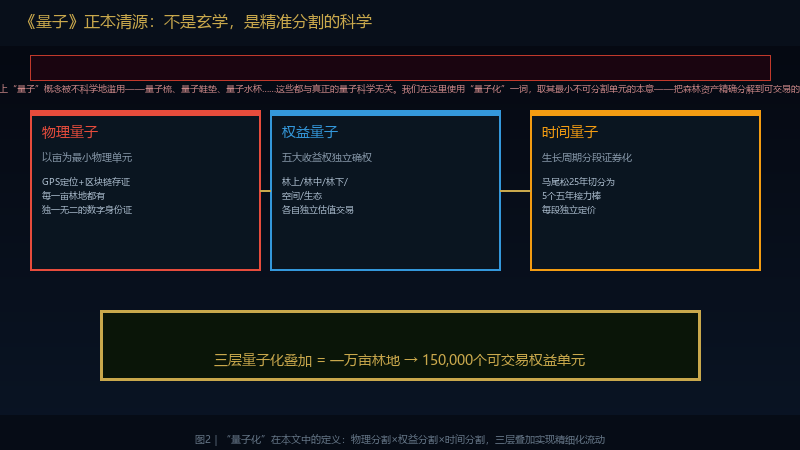
Figure 2|The definition of “quantization” in this article: physical division × rights division × time division — three layers stacked to achieve refined liquidity of forest assets
III. Deconstructing Forest Income Rights Along Five Dimensions: One Forest, Five Sets of Rights
In F01 I mentioned that a single forest can “collect five rents” at the same time. Now let me unpack those five dimensions, because they are the “cutting lines” of quantum division.
First, canopy income rights. These cover fruit harvesting, leaf collection (for extracting active compounds), the cultivation of parasitic plants, and so on. Take Korean pine forests in the northeast: one mu of Korean pine yields about 30–50 jin of pine nuts a year; at 15 yuan per jin, that is roughly 600 yuan in annual income. This income right exists independently of timber ownership, and its cycle is short (it generates cash flow annually), which makes it well suited to investors seeking stable dividends.
Second, trunk income rights. These are mainly the income from timber and bark (including extractable active compounds). This is the core income of traditional forestry and the largest part of any valuation. But its cycle is the longest — 25 years for masson pine, 60 years or more for Korean pine. Under the quantum framework, this “long cycle” can be turned into a series of “short-cycle relay batons” through time division (developed in Section IV).
Third, understory income rights. These cover understory cultivation and breeding — Chinese medicinal herbs, edible fungi, beekeeping, free-range chickens in the forest, and so on. This is one of the parts I value most, because it is the key to achieving “short-long combination” and creating cash flow before the trees reach merchantable size. One mu planted with poria in the understory can yield 3,000–5,000 yuan a year — earlier and steadier than the final-felling income from the timber itself.
Fourth, forest spatial income rights. These cover forest tourism, wellness retreats, nature education, camping, outdoor sports, and more. This income does not consume forest resources; it is a pure experience economy. Japan’s “forest bathing” (Shinrin-yoku) industry is worth more than USD 20 billion a year; Finland has incorporated forest wellness into its national health strategy. In China, “forest wellness” has been written into the development plans of the National Forestry and Grassland Administration — a blue-ocean market that is now taking off.
Fifth, ecological value income rights. These are mainly forestry carbon sinks (CCER), biodiversity compensation, and water-conservation ecological compensation. Although the methodologies and trading mechanisms are still being refined, as a core pillar of the global carbon-neutrality process this dimension has astronomical growth potential — the World Bank estimates that by 2030 the global carbon market could be worth more than USD 500 billion.
These five categories of income rights are independent, separately valued, and each attracts its own investor preference. Those who like stable cash flow can buy canopy income rights; those who like long-term value growth can buy trunk timber income rights; those who like high growth potential can buy ecological carbon sink income rights — the same forest serving investors with different risk appetites. That is unthinkable with traditional assets.
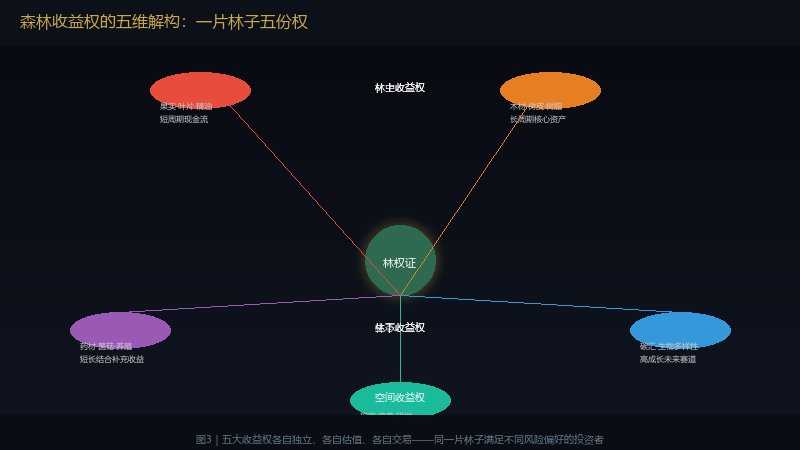
Figure 3|Five income rights, each independent, each separately valued, each separately traded — one forest can serve investors with different risk appetites
IV. The Three-Layer Architecture of Quantum Division: From Mountain Forest to Token
With the five-dimensional income rights as the “cutting lines,” the next question is technical: how to cut. In practice I have designed a three-layer, progressively deeper architecture of quantum division.
4.1 Layer One: Physical Division
Using the mu as the smallest physical unit, the forest land is divided geographically. One mu of forest land is one physical quantum. Combined with precise GPS positioning, high-resolution remote sensing imagery, and blockchain attestation, every mu of forest land carries a unique “digital identity” — recording its exact coordinates, area, topography, soil type, species composition, and age structure. This is the physical foundation for all division at the higher layers.
10,000 mu of forest land → 10,000 physical quanta.
4.2 Layer Two: Rights Division
On the basis of each physical quantum (one mu of forest land), the five income rights — canopy, trunk, understory, spatial, and ecological — are separately titled, separately valued, and separately created as independent rights certificates. In this way the old, undifferentiated notion of “one mu of forest land” splits into five independently tradable income quanta.
10,000 physical quanta × 5 income rights = 50,000 rights quanta.
4.3 Layer Three: Time Division (the Most Innovative)
Taking the different stages of the timber growth cycle as the cut points, we issue “relay-baton” rights products at different points in time. Using the 25-year final-felling cycle of masson pine as an example, it can be divided into five five-year relay batons:
- The first five years (juvenile stage): risk is slightly higher, but the discount is deepest and the potential return greatest — suited to risk-seeking investors.
- The second and third five-year periods (middle age): the trees enter their fast-growth phase and the asset appreciates fastest — suited to growth-oriented investors.
- The fourth and fifth five-year periods (near maturity): risk is lowest, the premium highest, and the returns steadiest — suited to conservative investors.
50,000 rights quanta × 5 time periods = in theory more than 250,000 tradable units. This is the power of “quantization”: a mountain, locked down for 25 years, is released into hundreds of thousands of financial particles that can be transferred at any time.
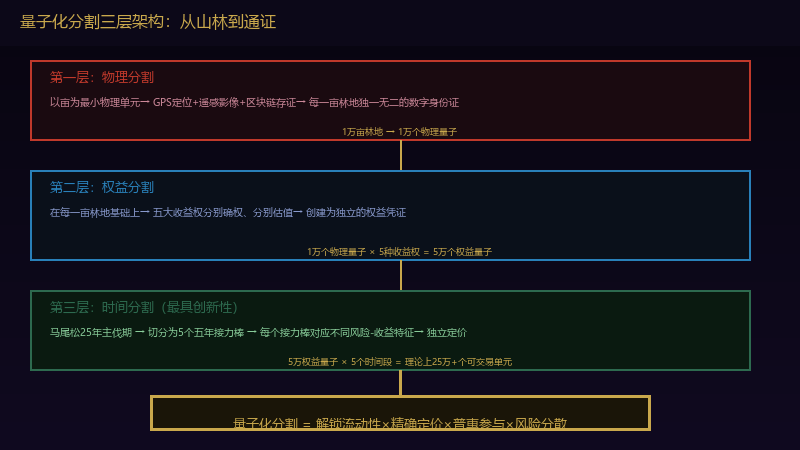
Figure 4|Three-layer quantum division architecture: physical × rights × time, leaping from 10,000 mu of forest land to 250,000+ tradable units
V. The Digital Foundation: A Space-Air-Ground Integrated Digital Twin
Of course, division is only the first step. Without a credible, real-time mechanism for disclosing asset information, even the finest division is nothing but words on paper. The precondition of quantum division is being “visible and credible” — and that requires a complete space-air-ground integrated digital twin system as its foundation.
Sky — satellite remote sensing. Gaofen-series satellites regularly capture high-resolution imagery of forest areas over wide regions, monitoring forest cover change, fire risk, and the early signs of pests and disease. Every few days, the “health check report” for the entire forest is automatically updated.
Air — drone inspection. Drones equipped with multispectral cameras and LiDAR conduct fine-grained inspections of priority forest areas — precisely measuring the diameter at breast height, height, and crown width of every tree, and building a three-dimensional digital twin model with centimeter-level accuracy. This is not “roughly how many trees” but “every tree has three-dimensional coordinates and a growth curve.”
Ground — an IoT sensor matrix. Soil multi-parameter sensors (moisture, temperature, pH, nutrients), micro-weather stations, carbon flux towers, and acoustic monitors (for pest early warning) are deployed across the forest, powered by solar panels plus batteries and transmitting data in real time over LoRa/4G networks. The “vital signs” of every mu of forest land are under continuous monitoring.
These three layers of data converge on our large forestry AI model platform, where deep-learning algorithms process and analyze them to deliver real-time valuation and dynamic risk ratings for every mu of forest land. Investors open the mobile app and see live imagery, growth data, and valuation changes for the patch of forest they hold — as convenient as watching a stock’s candlestick chart.
Once information asymmetry is thoroughly broken by technology, quantum division is no longer merely a concept but a piece of financial engineering that can be executed on the ground.

Figure 5|Space-air-ground integrated digital twin: making every tree “visible, credible, and tradable”
VI. From Quantum to Circulation: A New Era for Forest Asset Trading
At this point I want to stress one key thing: division is not the goal; circulation is.
Quantum division solves the problem of how to cut, but how to trade is the ultimate test. That requires a compliant, regulated, credible trading venue — the mission carried by the China Forestry Property Rights Exchange (and by the national-level forestry property rights exchange we are working to establish).
We are working to upgrade the forestry exchange from a traditional “property transfer hall” into a “digital forest asset trading platform” — so that divided forest income rights can be listed, matched, settled, and delivered like shares. Imagine this:
- A white-collar worker in Shanghai spends 1,000 yuan on her phone to buy the canopy pine-nut income rights over 0.5 mu of Simao pine forest in Yunnan, and receives 80–120 yuan in dividends every autumn.
- A fund manager in Beijing adds a “forest income rights index fund” to his asset allocation, covering one million mu of forest land nationwide across different species, regions, and income types.
- An institutional investor in Singapore invests, through RWA digital tokens, in the carbon sink income rights over 100,000 mu of Korean pine forest in the northeast — as a core holding in its ESG portfolio.
This is no longer a vision. It is already happening. When forest assets turn from “one whole mountain” into “hundreds of thousands of tradable financial particles,” when every tree can be precisely priced and freely transferred — the financial value of the forest will be released as never before. And that released force will in turn become the most powerful driver of forest protection.
Conclusion: Liquidity Is the Ultimate Amplifier of Forest Value
Back to the core logic of this series:
F01: The forest is the greatest financial asset the universe has given humanity. F02: But to truly “financialize” it, we must first solve “liquidity.” And the key to solving liquidity is “quantum division.”
When 10,000 mu of forest is no longer one asset but 250,000+ tradable units; when a mountain forest no longer has to be bought and sold as a whole but can be traded share by share like a stock; when forest income rights are no longer the exclusive preserve of a few insiders in the “forestry circle” but an inclusive financial asset that any ordinary person can allocate — on that day the forest will finally deliver the value it deserves. And protecting the forest will shift from a “moral requirement” to an “interest-driven” choice, from “the responsibility of a few” to “the rational choice of all humanity.”
In the next article I will examine reform of the forest tenure system — how institutional innovation can provide a solid legal foundation for the quantum division of forests. Stay tuned.
────────────────────────────────────
Next up: F03 Reform of the Forest Tenure System and Separation of Income Rights — Clearing Institutional Obstacles for Forest Assetization
────────────────────────────────────
— Foreststellar · Perpetual Forest Management Series —