Forest Is the Greatest Financial Asset the Universe Has Given Humankind

Forest Is the Greatest Financial Asset the Universe Has Given Humankind
From “lucid waters and lush mountains” to “mountains of gold and silver” — the financial logic
Original by Foreststellar · Xu Li
Starting today, I want to use a serialized series to systematically lay out my thinking over these past years on forest assetization and perpetual forest management. These ideas were not dreamed up in an office; my team and I spent the past few years walking them out ridge by ridge — from the Korean pine forests of the Changbai Mountains in the northeast to the Simao pine bases of Pu’er in Yunnan, from the understory ginseng fields of Tonghua in Jilin to the shrub ajania producing areas of Medog in Tibet.
In this opening chapter I want to answer one fundamental question first: why is the forest the greatest financial asset the universe has given humankind?
The question looks simple, but to do it justice we need to reacquaint ourselves with the forest along three dimensions: first, the forest’s true scale and standing in the Earth’s life system; second, the severely underestimated symbiotic relationship between forests and human civilization; and third, the unique financial attributes a forest possesses as an asset class — attributes that surpass every traditional asset.
1. The Grand Narrative of Global Forests: A Web of Life Spanning 4.06 Billion Hectares
To understand the financial value of forests, we must first understand their life value — because all financial value is ultimately rooted in real-world usefulness.
According to the FAO’s Global Forest Resources Assessment 2020, the world’s forest area is about 4.06 billion hectares, or 31% of the Earth’s land area. What does that mean? Spread out, the planet’s forests would cover the entire African continent with room to spare. Tropical rainforests account for 45% of that, boreal coniferous forests 27%, temperate forests 16%, and subtropical humid forests 11%.
Now look at China: 220 million hectares of forest, a forest coverage rate of about 23%, and a growing stock of 17.56 billion cubic meters. One figure is a particular point of pride: China’s planted forest area stands at 79.54 million hectares, the largest in the world, accounting for 27% of the global total. That means we are not only “protecting” forests — we are “creating” them. That is an extraordinarily important foundation for the financial narrative.
But those are only area figures. The forest’s real value lies in its identity as the Earth’s largest carbon pool. Global forest carbon stock is about 662 billion tonnes (biomass, soil, litter, and deadwood), close to three times the total carbon dioxide in the atmosphere. In other words, if all forests disappeared, atmospheric CO2 concentrations would soar from today’s roughly 420 ppm to more than 1,200 ppm — and human civilization would cease to exist.
Forests are also the planet’s greatest host of biodiversity. More than 80% of terrestrial biodiversity lives in forest ecosystems. A single hectare of tropical rainforest may hold more than 400 tree species, thousands of insect species, and hundreds of bird species — in the language of finance, that “species density” is called “value density.”
An even more direct figure: about 1.6 billion people worldwide depend directly on forests for their livelihoods — for food, fuel, building materials, and medicine. Forests produce roughly 50% of the world’s oxygen (the other half comes from marine algae), conserve most of the planet’s freshwater, and regulate regional climate and rainfall patterns. In one sentence: no forests, no human civilization.
Yet one brutal reality remains: roughly 10 million hectares of forest still disappear every year. That pace has fallen markedly from 16 million hectares a year in the 1990s — China’s large-scale afforestation and Natural Forest Protection Program deserve much of the credit — but it still means a football-field-sized patch of forest vanishes every six seconds. This trend of “intensifying scarcity” is precisely the greatest driver behind the revaluation of forests as an asset.
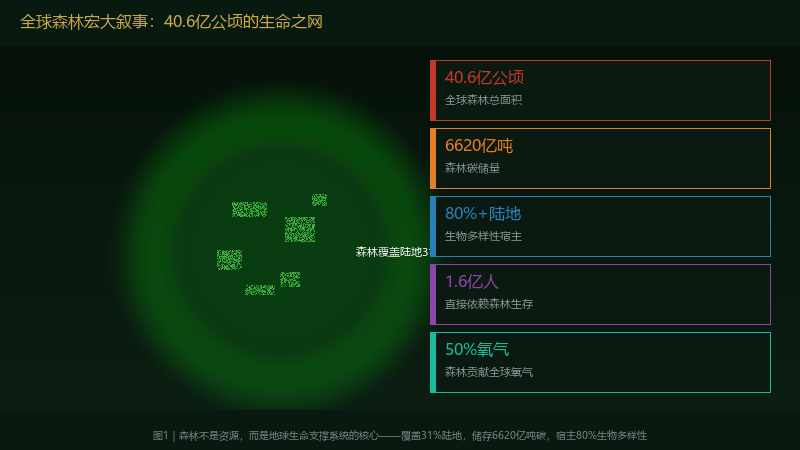
Figure 1 | Forests cover 31% of the Earth’s land area, hold 662 billion tonnes of carbon, and host more than 80% of terrestrial biodiversity — this is not a “resource” but the core of the planet’s life-support system
2. Forests and Humanity: A Symbiosis from Cradle to Cornerstone of Civilization
Humanity walked out of the forest. That is not poetic flourish but hard evolutionary fact. Our primate ancestors lived in forests for more than 60 million years — 6,000 times the roughly 10,000-year history of human civilization. Which means every cell in our bodies, every gene, every metabolic pathway evolved through deep interaction with the forest.
This symbiosis shows up in every dimension of human civilization:
Oxygen and water — the baseline supply of life. Through photosynthesis, forests contribute nearly half the oxygen in the Earth’s atmosphere. The interception, storage, and gradual release of rainfall by forest soils and canopies is a core link in the global freshwater cycle. Without water conserved by forests, the Yangtze, the Yellow River, and the Amazon — cradles of human civilization — would not exist.
Building materials and energy — the material basis of civilization. From the first day humans left the cave, wood has been the most basic building material, heating fuel, and raw material for tools. Even in the 21st century, about 4 billion cubic meters of wood are harvested and used worldwide each year — more than steel, cement, and plastics combined. Wood-based biomass still accounts for more than 45% of global renewable energy.
Food and medicine — the system that sustains life. Forests supply a substantial share of the protein (understory mushrooms, forest berries, edible insects), fats (woody oil crops such as oil-tea camellia, walnut, and olive), and micronutrients in the human diet. Not to mention — as I explored in depth in the F05 series — that forests are the Earth’s largest natural pharmacy: about 65% of FDA-approved small-molecule anticancer drugs are derived directly or indirectly from natural products.
Culture and spirit — the superstructure of civilization. From the Norse “world tree” (Yggdrasill) to the Daoist principle of “the Way follows nature,” from Japan’s “forest bathing” (Shinrin-yoku) to Finland’s “grandfather’s tree” tradition — the place of forests in the human spiritual world runs far deeper than we ordinarily realize. The forest is humanity’s “spiritual point of origin.”
Climate regulation — a global public good. Forests regulate regional climate through transpiration, slow global warming through carbon sequestration, and sustain ecosystem resilience through biodiversity. According to the classic study by Robert Costanza and co-authors in Nature, these “ecosystem services” are worth an estimated USD 125–145 trillion a year worldwide — more than total global GDP.
If we accept the basic fact that humanity cannot survive without forests, then a forest is not a “resource” that can be swapped out at will — it is “infrastructure” for human civilization. And infrastructure, by the definition of finance, is born to be an asset. The highest-grade asset there is.
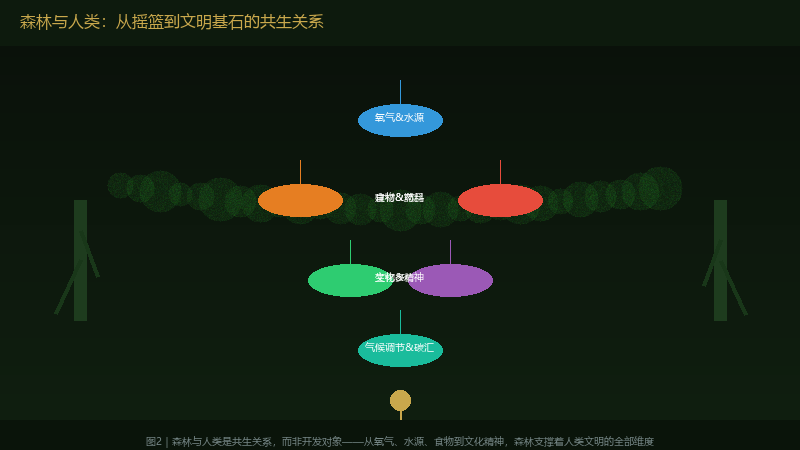
Figure 2 | Forests and humanity are locked in symbiosis — from oxygen, water, building materials, food, and medicine to culture and spirit, forests underpin every dimension of human civilization
3. Dissecting the Forest’s Financial Attributes: The Ultimate Asset Beyond Gold
Let us turn to the heart of this article: as an asset class, what exactly makes a forest good?
3.1 The Essential Definition of an Asset
By the textbook definition, an asset is an economic resource owned or controlled by an enterprise, an individual, or a state, whose income can be measured in monetary terms. My own formulation is simpler: an asset must satisfy three basic elements — describable, priceable, tradable. A forest satisfies them perfectly.
But the financial attributes matter more. The stronger an asset’s financial attributes, the more investors chase it — and the more excess value can be unlocked from it. Financial attributes likewise rest on three basic elements: liquidity, scarcity, and storability (pledgeability).
3.2 Forest vs. Gold: The Ultimate Showdown
What asset in today’s world has the strongest financial attributes? The first thing most people think of is gold. True enough: gold is close to perfect on all three dimensions of liquidity, scarcity, and storability. But gold has two fatal weaknesses:
First, gold is of little intrinsic value to humanity. It has use value in certain electronic components and in decoration, but it does not meet a hard necessity. The data speak clearly: 91.77% of global gold use goes to jewelry, bullion, and central bank reserves — all human “self-defined” uses — and under 10% to genuine industrial need. Put bluntly: humanity can live perfectly well without gold.
Second, gold cannot appreciate on its own. Put a kilogram of gold in a safe for a hundred years and it is still a kilogram. It does not grow, reproduce, or generate any additional value. It is “dead.”
Now consider the forest:
First, the forest has an irreplaceable hard-necessity value for humanity. Without the oxygen forests contribute, humans cannot breathe; without the water forests conserve, humans cannot drink or irrigate; without the building materials forests provide, infrastructure costs would become unbearable; without forests as hosts of biodiversity, the entire ecosystem’s food chain would collapse. Humanity cannot survive without forests. Gold can never match that hard-necessity attribute.
Second, the forest appreciates on its own — the core magic of a “living asset.” From the young and middle-aged stage onward, a forest grows larger and thicker every year. Over a masson pine’s 25-year rotation, trunk volume can increase hundreds of times over. More crucially, every single day the forest accumulates biodiversity — flowers, birds, insects, animals, microbes — and every organism is a potential resource. A kilogram of gold does not give birth to little gold, but a tree “gives birth” every year to new wood, new leaves, new fruit, and new ecosystem services.
Look at the three financial attributes:
Storability (pledgeability) — beyond doubt. A forest can persist for centuries, even millennia. A forest fire is not “destruction” but part of the forest’s natural succession — after the burn, the forest is reborn with greater vitality.
Scarcity — and this is the interesting part. On one hand, the past few decades have seen massive global forest loss, and against humanity’s hard needs the forest area is precarious. On the other hand, the forest’s absolute global stock (4.06 billion hectares) is an enormous base. This “scarcity atop a huge base” is precisely what makes for a perfect financial asset: scarcity creates value, while the huge base ensures market depth and stability.
Liquidity — the attribute forests have been most criticized for. A forest tract easily runs to tens of thousands of mu, with a growth cycle of decades. Without an effective mechanism to break it into small-denomination, standardized, tradable asset units, it can only ever be a single large piece of real estate — never a financial product the public can invest in. And that is exactly where a tremendous wealth breakthrough lies. Solve this problem and a trillion-scale opportunity opens up. It is precisely what I will explore in later chapters (F02 quantum division, F09 fixed-income products, F10 Forest Coin/RWA).
Gold
Forest
Figure 3 | Forest vs. gold: forest = gold’s financial attributes + life’s hard-necessity value + the “living asset” magic of self-appreciation
3.3 The “Four Unique Advantages” of Forest Assets
First, biological growth delivers a 20% annualized return. Take the most common species, masson pine: over its 25-year rotation, planting costs about RMB 2,000 per mu, plus about RMB 3,000 in tending costs over 25 years — roughly RMB 5,000 all in. At final felling in year 25, one mu of masson pine yields about 15 cubic meters of timber; at a market price of about RMB 900 per cubic meter, that is about RMB 13,500 in revenue. Add comprehensive income such as the understory economy over those 25 years, and total revenue can exceed RMB 25,000. In other words, RMB 5,000 in becomes RMB 25,000 after 25 years — about a fivefold gain, an annualized return of roughly 20%. Against gold (about 7% a year), real estate (about 5–8% a year), and equity indices (about 8–10% a year) over the same period, forest assets lead by a wide margin at 20% annualized growth. More striking still: that 20% comes not from leverage, not from speculation, not from luck — but from the free photosynthesis nature performs every single day.
Second, a natural hedge against inflation. Inflation is at bottom the dilution of purchasing power caused by excess money creation. But trees do not stop growing because a central bank prints money. On the contrary, timber and forest product prices tend to be positively correlated with inflation — the higher inflation runs, the more real assets are worth. A forest combines the hard-currency property of a real asset with the extra appreciation of biological growth — a dual advantage neither gold nor real estate possesses.
Third, diversified and three-dimensional stacked returns. In one tract of forest, the canopy offers pine cones and leaves to harvest, the trunk offers timber and bark to convert, the understory offers medicinal herbs and mushrooms to cultivate, the forest space supports tourism and wellness retreats, and the whole carries carbon sink and ecological value. These five income directions do not exclude one another and can run simultaneously. Buy a house and you collect one rent; buy a stock and you can only hope for price gains and dividends; buy a forest and you collect five rents at once. Such stacking of returns is extremely rare in the financial world.
Fourth, a globally recognized asset — value consensus without borders. Whether you are Chinese, American, or European, whatever ideology you believe in, you need timber, forest products, clean air, and water. Forests are the hard-necessity infrastructure of human survival. That global consensus gives forest assets a natural claim to becoming a global financial asset — like gold, recognized across borders and cultures alike. And forests have one dimension gold lacks: they are not only “a store of value” but “a source of life.”
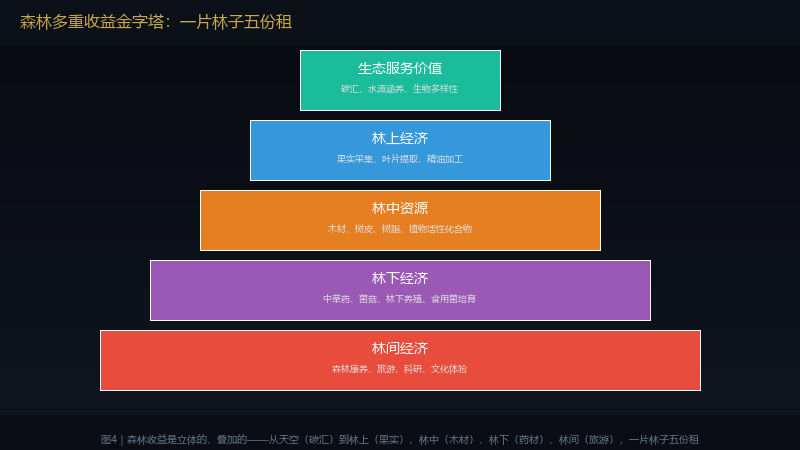
Figure 4 | Forest returns are three-dimensional and stacked — from the sky (carbon sinks) to the canopy (fruit), the trunk (timber), the understory (medicinal herbs), and the spaces between (tourism): one forest, five rents
4. Why Is the Financialization of Forests So Far Behind?
At this point you may ask: if forests are this good, why have they never become a mature financial asset class? I see four core obstacles — and those four obstacles are precisely where the biggest opportunity lies.
4.1 The liquidity obstacle
A single forest tract easily runs to tens of thousands of mu, with a growth cycle of 25–60 years. Without an effective mechanism to break it into small-denomination, standardized, tradable asset units, it can only ever be one large piece of real estate, never a financial product the public can invest in. Imagine: if every mu of forest could be bought and sold on an exchange like a share of stock, what enormous liquidity would global forest assets release? That is exactly the quantum division we will examine in the next chapter.
4.2 The cognitive obstacle: the “low-end image” of traditional forest products obscures the forest’s high-tech potential
This is, I believe, the most overlooked obstacle — and also the most fundamental.
Mention forests and forest products, and what is most people’s first reaction? Timber, paper, furniture, chopsticks, charcoal. In the public mind, the forest processing industry is a traditional business of “fell the tree, saw the log, sell the board” — dirty, grueling, low value-added, low tech. This deep-rooted “low-end image” has two severe consequences: first, the cold shoulder from capital markets — no fund manager thinks “wood processing” deserves a heavy position; second, misallocated policy resources — forests have long been lumped into “big agriculture” and get none of the policy dividends enjoyed by high-tech industries.
The truth is the opposite. Forest raw materials are becoming the core supply end of the 21st century’s most advanced technology industries. Let me give a few examples that are already happening or about to:
In food, modern biotechnologies such as supercritical CO2 extraction, enzyme engineering, and synthetic biology are turning the forest’s functional compounds — flavonoids, terpenoids, polysaccharides, polyphenols — into precision-nutrition foods, meal-replacement ingredients, and gut-microbiome modulators. This is not a “local specialty”; it is molecular-level precision food engineering. (See the forthcoming F05 chapter.)
In biomedicine, the forest is the world’s largest library of natural compounds. Paclitaxel (anticancer), camptothecin (colorectal cancer), vinblastine (leukemia) — these blockbuster “king” molecules, each worth tens of billions, all come from forest plants. And about 65% of FDA-approved small-molecule anticancer drugs derive directly or indirectly from natural products. The forest is not an “herbal shop”; it is humanity’s frontline arsenal against disease. (See the F05 biomedicine chapter.)
In cosmeceutical skincare, Pycnogenol (maritime pine bark extract, with 50 times the antioxidant capacity of vitamin C), glabridin (16 times the skin-brightening effect of hydroquinone with no cytotoxicity), and betulin (which promotes collagen synthesis) — the global natural cosmetics market has already reached USD 40 billion and is growing 8–10% a year toward a USD 70 billion cosmeceutical market. Forests are defining the future of “beauty.” (See the F05 chapter.)
In advanced polymer materials, lignin — the papermaking by-product the world generates at 50–70 million tonnes a year — is being nanomodified into the core feedstock for carbon fiber precursors (at one-third the cost of conventional PAN-based carbon fiber), reinforcing agents for biodegradable plastics, and high-performance adsorbent materials. Nanocellulose — fibers just 5–20 nanometers in diameter extracted from wood — is five times stronger than steel at one-fifth the weight, and is being used to make next-generation lightweight auto parts and aerospace composites. (See the F05 wood-based new materials chapter.)
In the most advanced hard-tech fields, the application boundary of forest raw materials keeps being pushed to the limit. Lignin-based phenolic resin is emerging as a potential substitute feedstock for photoresists in chip manufacturing — once that breaks through, it will leap from “papermaking waste liquor” to “mother of chips.” Cellulose nanofibers, with their excellent biocompatibility and programmable degradation, are being explored for flexible actuators in soft robotics and for biodegradable electronic devices. From forest to chip, from tree to robot — this is not science fiction but a materials revolution already under way.
While the public’s idea of forests is still stuck at “timber plus paper,” forest raw materials are already blooming across six frontier fields: food technology, biomedicine, cosmeceutical skincare, polymer materials, chip manufacturing, and robotics. Breaking through this “cognitive barrier” is the first gate on the road to forest financialization — because capital always chases imagination, and imagination has to be “seen.”
4.3 The property-rights obstacle
The property-rights complexity of a forest far exceeds that of any other asset class — ownership, contracted management rights, operating rights, timber ownership, understory operating rights, canopy collection rights, carbon sink income rights, biodiversity rights, and the forest spatial income right (tourism, wellness, nature education)… These rights belong to different holders and nest within and check one another. The forest spatial income right deserves particular emphasis — the most easily overlooked yet commercially explosive rights dimension. For a beautifully scenic primary or planted forest, the value of spatial experiences such as forest bathing, wellness retreats, nature education, and outdoor exploration often far exceeds the value of the timber itself. Japan’s “forest bathing” industry is worth more than USD 20 billion a year, and Finland’s forest wellness has become part of its national health strategy — and all of it must be realized through the titling and trading of the “forest spatial income right.” Without institutional innovation to clarify, separate, and title these rights, financialization cannot even begin. China’s collective forest tenure reform has already achieved a great deal, but on the dimension of “separating and circulating rights” there is still ample room for innovation.
4.4 The income-cycle obstacle
Forestry investment’s long-cycle nature (25–60 years) stands in fundamental contradiction with capital’s pursuit of short-term returns (typically 3–5 years). A masson pine needs 25 years to reach merchantable size; a Korean pine needs 60 years to enter full fruit production. Under the traditional financial framework, an investment cycle like that is unacceptable. But the way through has already appeared: through financial innovations such as asset-backed securities (ABS), income-right trusts, and RWA digital tokens, we can turn the forest — a 25–60 year long-cycle asset — into financial products tradable annually, quarterly, or even monthly.
These four obstacles are not the forest’s “defects” but innovation’s “entry points.” Every obstacle broken releases trillion-scale value.
5. Breaking Through on Forest Assetization: What We Are Doing Now
For the past three years, my team and I have been pushing forward on all three fronts at once.
5.1 Property-rights innovation: separating and titling rights
We are already advancing pilot work on the separation of multiple forestry income rights in several provinces, municipalities, and districts. The core idea: separate canopy harvesting rights, understory operating rights, carbon sink income rights, biodiversity rights, and others out of the traditional forest tenure, then title, value, and trade each one separately. A 100,000-mu forest thus stops being “one” asset and is broken into a dozen or more “asset packages” that can be priced and traded independently — transfer thresholds drop sharply, and investors can buy only the “understory herb income right” or only the “carbon sink income right,” according to their own preferences and risk tolerance.
5.2 Breaking the liquidity barrier: a digital trading platform
Within the framework of the China Forestry Property Rights Exchange, we are driving the construction of a digital trading platform for forest assets. The core instrument is “space-air-ground integrated” digital twin technology: high-resolution satellites scan each forest parcel’s growth on a regular schedule, drones carry multispectral cameras for fine-grained inspection, and ground-based IoT sensor arrays monitor soil, moisture, temperature, and carbon flux in real time. Every tree and every inch of soil in every parcel is digitized, visualized, and made real-time. Once a forest becomes “visible and credible,” its trading becomes “anticipated and feasible.”
5.3 Financial innovation: from ABS to RWA
We are designing asset-backed securities (ABS) and real-world asset (RWA) digital tokens built on the forest’s biological growth. The goal is to turn the forest — a long-cycle asset — into standardized financial products that can circulate on secondary markets — just as REITs let ordinary people invest in commercial real estate, Forest REITs and Forest RWA will let ordinary people invest in forests. Imagine opening a mobile app, spending RMB 100 to buy the carbon sink income right over 0.1 mu of Simao pine forest in Yunnan, and receiving a 5–8% dividend every year — the forest is no longer a distant “large piece of real estate” but an inclusive financial asset within reach.
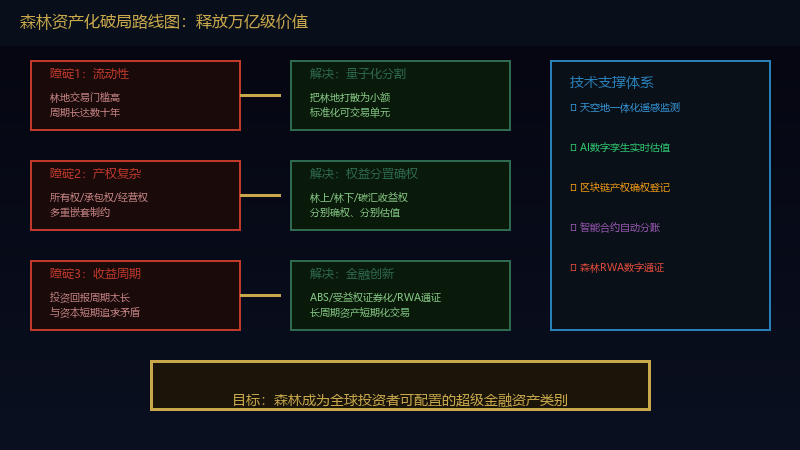
Figure 5 | Roadmap for breaking through on forest assetization — from property-rights innovation to a digital platform to financial product innovation; every obstacle broken releases trillion-scale value
Conclusion: Once a Forest Becomes an Asset, Protection Is No Longer a Moral Duty but a Matter of Self-Interest
My purpose in writing this article is not just to tell an investment story but to lay out the logic of a civilizational transition.
For decades, the core dilemma of the global environmental movement has been this: “protecting forests” relies on morality, on sentiment, on government subsidies — all of which matter, but none of which is strong enough or durable enough. Morality tires, sentiment fades, and government subsidies swing with the fiscal cycle. The only thing that can drive human behavior sustainably is self-interest.
If the owner of a forest — whether a state, a company, a village collective, or an individual — can earn a sustained, substantial, and stable economic return from that forest, then that owner has the strongest possible incentive to protect it, manage it, and keep it standing forever. Not because “I ought to,” but because “I benefit.”
“The best way to protect a forest is to make it valuable. The best way to make it valuable is to make it an asset. The best way to make it an asset is to make it tradable.”
When every mu, every tree, every tonne of carbon sink, and every thread of biodiversity across the world’s 4.06 billion hectares of forest is precisely measured, fairly priced, and freely traded —
the forest will no longer be merely “lucid waters and lush mountains” but, in the truest sense, “mountains of gold and silver” — a super financial asset capable of delivering stable, substantial, and sustainable returns to investors worldwide. That is the cause my team and I are working for.
In the next article, I will elaborate on the “quantum division of forest assets” — how to break a 100,000-mu forest into one million freely transferable asset units. Stay tuned.
─────────────────────────────────────
Next up: F02 Minimal (Quantum) Division of Forest Assets — Solving Liquidity, Part One
─────────────────────────────────────
— Foreststellar · Perpetual Forest Management Series —