Outlook: Taking the First Step Toward Interstellar Tree Planting
Perpetual Forest Management Series · Part Twelve
F012 Outlook: Taking the First Step Toward Interstellar Tree Planting
Let humanity’s interstellar migration have warmth, oxygen, and flowers in bloom
Author: Xu Li | WeChat Official Account: Foreststellar
If in the previous eleven articles we have been discussing how to manage a forest on Earth into an asset that generates value continuously, then in this one I want to look further out — beyond Earth.
The environments humanity may face in the future run in only two directions: at the largest scale, interstellar migration; at the smallest, migration and settlement within Earth under environmental stress. But wherever we go, one thing never changes — plants and trees are the companion life humanity can never do without. For only when a plant takes root, sprouts, and puts out green leaves on new soil does a strange habitat truly begin to be called “home.”
This is also why we, as a forestry company, want to take part in interstellar migration projects. Starship V3 completed its first flight in 2026, and Musk has made clear that Starship will be used for the Moon and Mars; third parties such as ispace are already booking capacity and running a lunar cargo “shuttle service.” That means the payload interface is opening up — but one badly neglected fact is that almost every Mars plan talks about rockets, energy, and water, while very few seriously answer one question —
“Once we arrive, how do we make a place grow a sense of life?”
And that is precisely forestry’s home turf. Human interstellar migration must have warmth; it must have the company of plants and trees — they hold soil and water in place, absorb carbon dioxide, release oxygen in a cycle, improve living space, and regulate human mood. Each of these five functions is a hard requirement for survival beyond Earth.
1. First, Get This Clear: Interstellar Migration Faces Only Two Kinds of Environment
Simplify a complex problem and the habitats human interstellar migration must face come down to just two:
The first: a planet with oxygen. But “has oxygen” does not equal “can grow trees” — gravity, native soil, radiation, air pressure, temperature swings: any one of them can leave Earth plants unable to survive.
The second: an oxygen-free environment. The Moon, deep-space ships, and most interstellar bases have no breathable atmosphere. Humans can survive only by building closed, artificially cycled oxygen-generating spaces.
These two environments correspond to two completely different technical paths. I will set out each in full below.
Enclosed greenhouse + regolith bioremediation A four-person base needs roughly 80–100 m² of plant cabinPath one: oxygen present, but a hostile surface
Path two: an oxygen-free, closed life-support cabin
▲ The two paths of interstellar tree planting: an oxygen-bearing hostile surface vs. an oxygen-free closed life-support module
2. Path One: An Oxygen-Bearing but Hostile Alien Surface — Mars as the Example
Start with a brutal judgment: even if we find a planet with oxygen, growing trees in the open will be almost impossible. Take Mars: the real conditions are extremely hostile.
Surface atmospheric pressure on Mars is only 0.6% of Earth’s, and water is in a state where it boils without ever being heated; the soil contains 0.5%–1% perchlorates, which are highly toxic; it has almost no organic matter or microorganisms; its water-holding capacity is only 30% of Earth’s soil; gravity is 38% of Earth’s; there is no magnetic field to shield against radiation; and the day–night temperature difference exceeds 100°C.
So the essence of this path is not “planting trees” but “building an Earth microclimate bubble on Mars” — using a closed, pressurized greenhouse plus regolith bioremediation, in four steps:
Step One: Isolate the Environment
Build growing modules inside lava-tube caves or pressurized domes, shutting external radiation, low pressure, and extreme temperatures outside. This is the first step, and the most basic engineering precondition.
Step Two: Amend the Regolith, Do Not Replace It
Shipping soil from Earth costs an astronomical sum per tonne. We must start from the local Martian regolith and gradually “manufacture soil”:
① Physical structure modification: use rockwool as a capillary substrate so that nutrient solution wicks upward through the regolith.
② Organic matter injection: mix in vermicompost to supply humus and a microbial carrier.
③ Microbial inoculation: arbuscular mycorrhizal fungi are the key — experiments show that only when mycorrhizal fungi and vermicompost are inoculated together can chickpeas in simulated lunar regolith flower and set pods; microbial consortia can also raise barley seedlings on simulated Martian soil.
Step Three: Choose Species — Start from “Functional Plants,” Not a Forest
What gets planted in the early stage is not trees but: the mainstays of oxygen production and carbon fixation (wheat, potatoes, soybeans, sweet potatoes); and nitrogen fixers (legume microgreens). And here is where forestry companies have their real entry point — shrubs, ornamental trees and shrubs, medicinal plants, and woody plants used for windbreaks, microclimate regulation, and psychological well-being. These are non-food functional plants, and they have a clear place in a life-support system.
Step Four: Gravity Adaptation
Mars’s 38% gravity alters root gravitropism and hormone distribution, and plants develop a kind of “spaceflight syndrome.” This step requires ground-based simulation experiments first — we could build a seedling platform combining 38% gravity simulation with Martian regolith simulant.
The core insight of this path is that what forestry companies sell has never been “trees” but the biological capacity to convert regolith into soil. Earth’s soil can grow things because a single gram of healthy arable soil contains hundreds of millions of microorganisms handling the nitrogen cycle. Moving that soil-making capability to Mars is a moat unique to forestry companies.
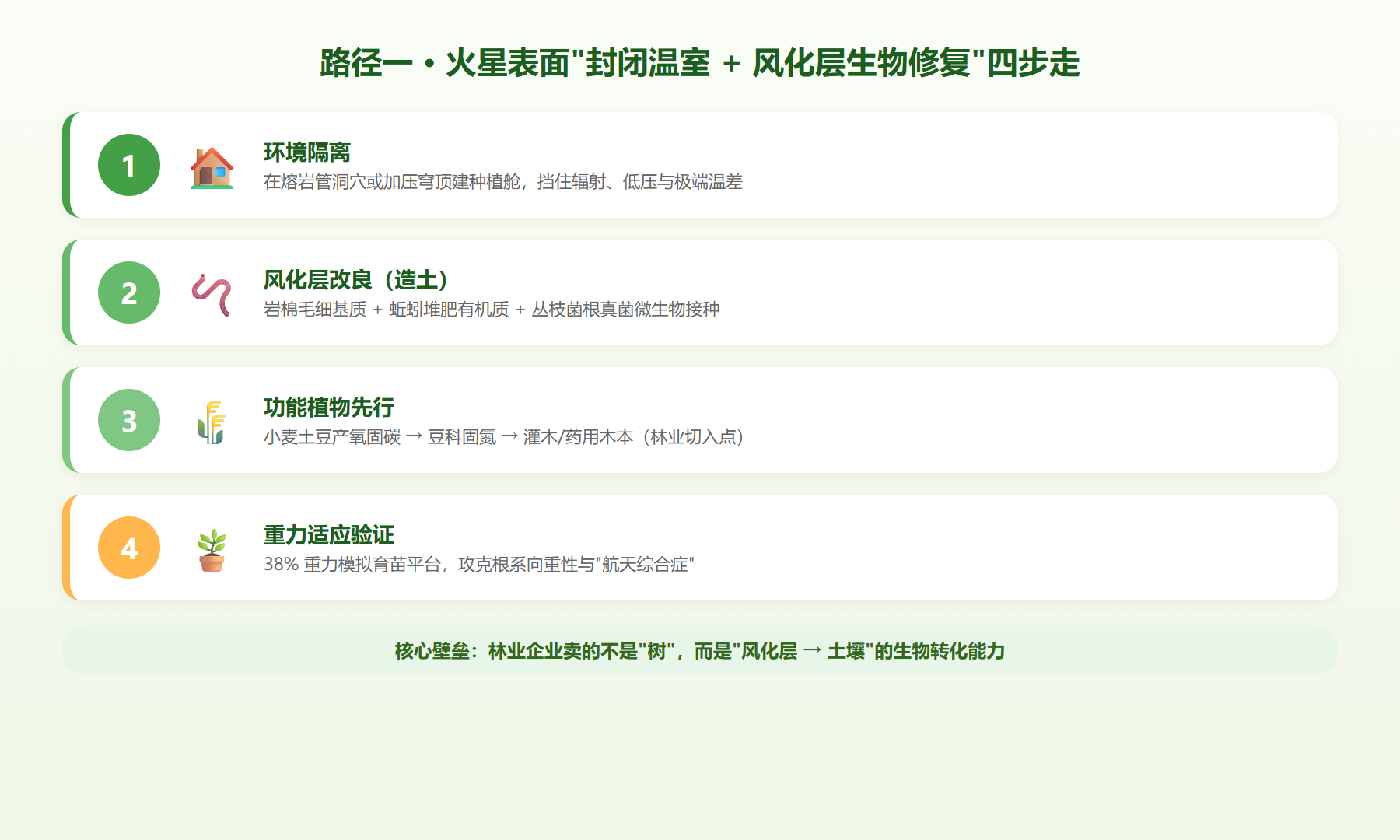
▲ Path One: the four-step “closed greenhouse + regolith bioremediation” approach on the Martian surface
3. Path Two: Closed-Loop Life Support in an Oxygen-Free Environment
This is the real main battlefield of “interstellar tree planting” — a fully artificial oxygen–water–carbon cycle aboard a spacecraft or in an alien base. The principle is not complicated; the key is the degree of closure:
Astronauts exhale CO₂ → plants absorb it through photosynthesis → O₂ is released → astronauts breathe; plants transpire → condensation → purification → drinking water again; human and animal waste → microbial decomposition → nutrient solution → back to the plants. This is a closed loop in which every link locks into the next.
China’s “Lunar Palace 1” has already demonstrated the feasibility of this path: in a space of 150 m² and 500 m³, three cohorts of volunteers lived continuously for 370 days, with a system closure of 98%, 100% recycling of oxygen and water, and most food supplied from within the system. It is the ground-based experiment closest to “interstellar forestry” anywhere in the world today.
NASA’s quantified engineering figures are: about 20–25 m² of crop-growing area supplies oxygen for one person, and about 50 m² supplies their dietary calories. In other words, a four-person Mars outpost needs roughly 80–100 m² of plant modules — that is the minimum scale of an “interstellar forest farm.”
The technical essentials of growing trees in this environment:
① No soil — use mist culture and air culture (aeroponics): roots hang in the air and are misted with nutrient solution on a schedule, giving water and fertilizer efficiency far higher than soil culture.
② Precise red-blue LED spectra: Mars receives only 43% of the sunlight Earth does, so supplemental lighting is essential.
③ Ethylene management: in a sealed space the ethylene that plants themselves produce accumulates to toxic levels, so a catalytic decomposition unit is essential.
④ Species selection: in the early stage, focus on dwarfed, fast-growing, high-oxygen-output woody species that are edible or medicinal — blueberries, goji berry, tea plant stems, dwarf apples; only in the middle stage consider ornamental tree seedlings.
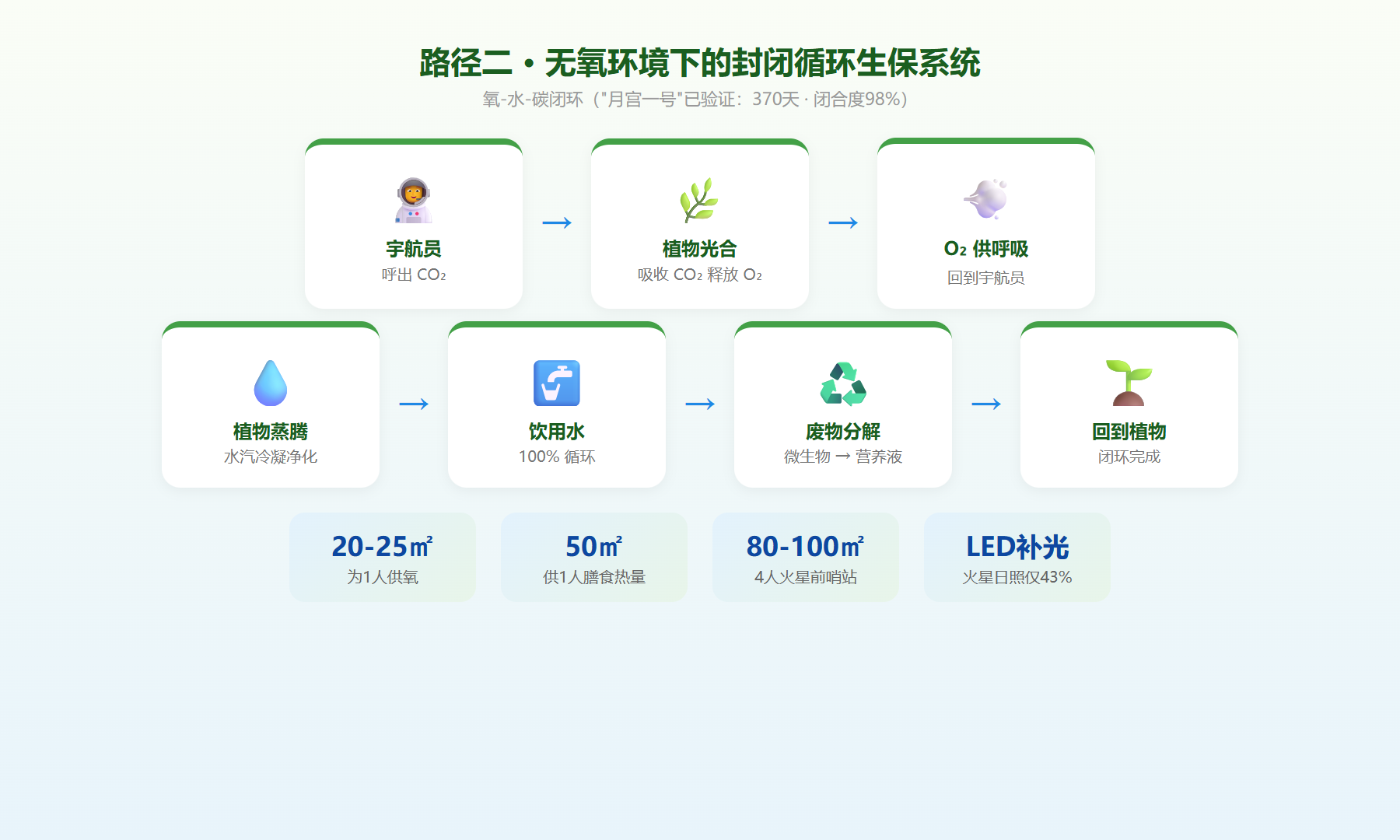
▲ Path Two: a closed-loop life-support system in an oxygen-free environment (the oxygen–water–carbon loop)
4. Are There Other Paths? — Five Easily Overlooked Models
The answer is yes, and forestry companies should focus on these five:
-
Seed and microbial-strain banks first, not whole plants first. The cost of shipping one tree from Earth is enough to ship a million seeds plus a thousand kinds of microbial spores. Forestry companies can lead the creation of an “interstellar afforestation seed–strain synergy package” — every seedling paired with its own set of mycorrhizal fungi and rhizosphere bacteria. That in itself is a high-value-added product.
-
Engineered soil production. Rather than relying on natural regolith, use water ice from asteroids or the lunar polar regions, plus substrates shipped from Earth, plus microorganisms, to manufacture artificial soil in orbit. “Engineered soil formulations” can become a core technology asset: a modular recipe of regolith, specific microorganisms, organic binders, and slow-release fertilizer, custom-designed for the target planet.
-
Vertical forestry in lava-tube caves. Both the Moon and Mars have enormous lava tubes that naturally shield radiation and hold a stable temperature. Converting caves into vertical forest farms, using a three-dimensional forestry approach, is a scenario to which Earth forestry companies’ experience in vertical planting can be transferred directly.
-
Bioreactor-style micro-ecosystems. Rather than growing whole trees, use plant-cell bioreactors to produce oxygen and extracts continuously, paired with algal systems. This is an intermediate form between life support and forestry; it is more controllable in engineering terms and suits use as a transitional product before “trees.”
-
Psychological well-being vegetation systems. This is the most valuable part of the original insight — the value of plants and trees to human psychology. In a long-term sealed interstellar environment, mental health is a decisive factor in mission success. Forestry companies can provide: ornamental flowering plants (mood regulation), aromatic plants (olfactory stimulation), shrubs that can be pruned interactively (horticultural therapy), and a “homeworld plants” conservation program (carrying representative plants of Earth’s cultures into space). No aerospace contractor is working on this today — it is forestry companies’ blue ocean.
5. Luxi Technology’s Brain-Inspired Large Model: Letting AI Rehearse the Evolution of “Interstellar Plants”
The hardest part of interstellar tree planting is that we cannot send every kind of plant into space to learn by trial and error. That is when we need a “brain” to run the simulations ahead of time — and that is exactly where the value of Luxi Technology’s brain-inspired large model lies.
In F11 I explained that neuromorphic computing uses spiking neural networks to emulate biological neural mechanisms, making it inherently low-power, event-driven, and close to biological signal transmission. Applied to the proposition of “interstellar plants,” it has three capabilities others cannot match:
First, predicting epigenetic change. By modeling multi-omics data — genome, epigenome, transcriptome, metabolome — together with environmental factors such as low gravity, high radiation, low pressure, high CO₂, and unusual spectra, it predicts how DNA methylation, histone modification, and small-RNA regulation will evolve in plants under interstellar conditions — which traits will be “switched on” or “switched off” — and screens out stress-tolerant, dwarfed, high-oxygen-output lines in advance.
Second, a digital twin of the growth model. Build a digital twin of a “Mars forest farm” to simulate tens of thousands of plant generations’ morphogenesis, photosynthetic efficiency, and changes in root gravitropism under low gravity and high radiation. Use the spatiotemporal computing characteristics of brain-inspired spiking networks to approximate the transmission mechanisms of plant hormone signals and electrical signals — the “sense of life” that conventional large models cannot compute.
Third, real-time edge-AI control. Luxi’s edge chips are low-power, respond in real time, and keep data inside the module, so they can be embedded directly in life-support modules for local, closed-loop control of LED spectra, nutrient-solution ratios, and CO₂ and ethylene concentrations. Interstellar bases are extremely energy-constrained, and this is precisely where brain-inspired chips’ compute-per-watt ratio crushes conventional GPUs.
In one sentence: Luxi’s brain-inspired large model is the “breeding simulation engine” and the “life-support control brain” we install for interstellar tree planting.
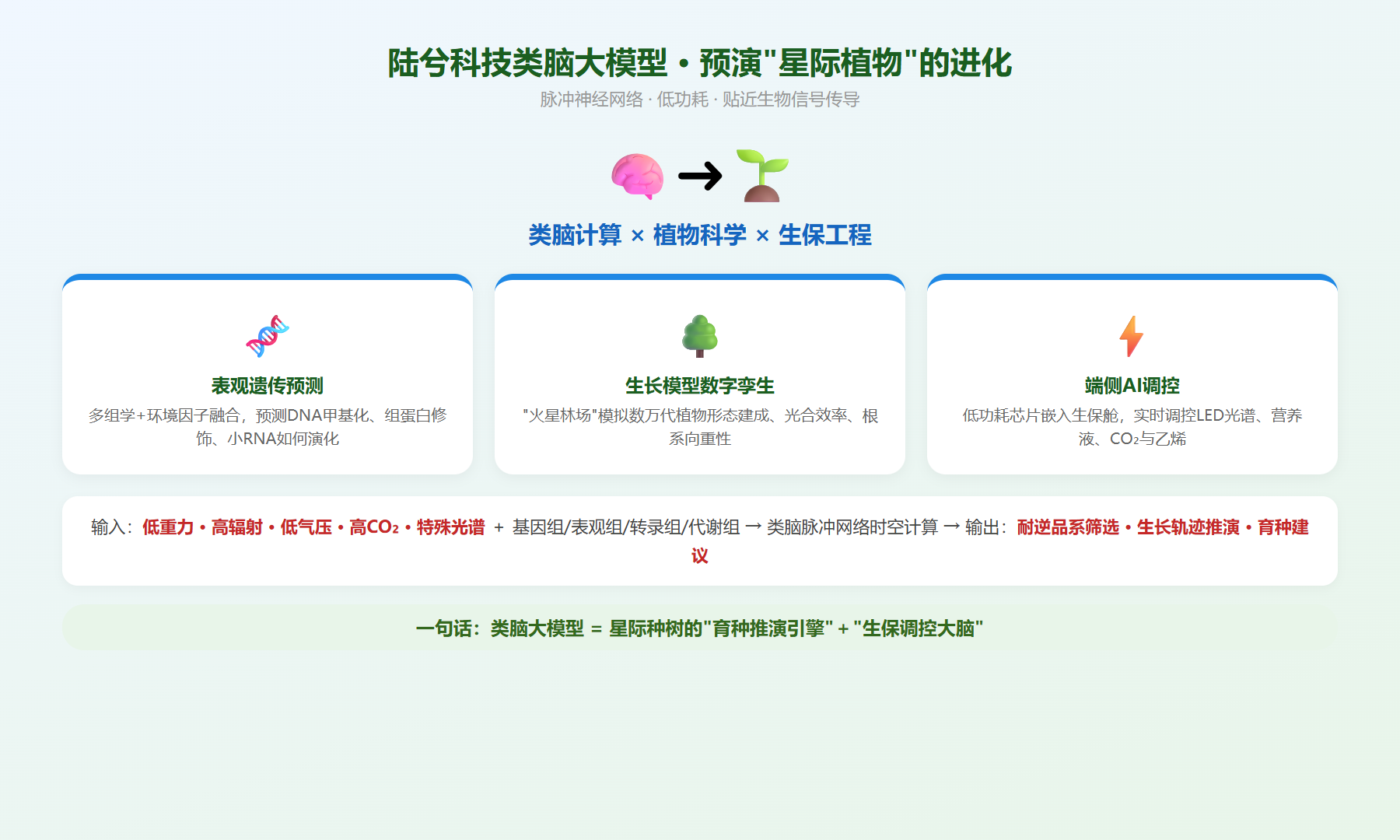
▲ Luxi Technology’s brain-inspired large model: epigenetic prediction for interstellar plants + a digital twin of the growth model
6. How Should International Forestry Leaders Begin Now? — A Three-Year R&D Roadmap
Calibrate the goal first: what we are building is not “planting trees on Mars” but an “extraterrestrial life-support forestry module.” The former is science-fiction narrative; the latter is an engineered product. And forestry companies’ real position in a life-support system comes down to three things: the biological capacity to convert regolith into soil; the breeding of functional plants and woody plants; and the engineering of the plant module within a closed-loop life-support system.
Year One (Y1): Ground-Based Experimental Capability + Incubating Core IP
① Build an “interstellar forestry” test module: a pilot-scale controlled-ecology life-support test chamber, with key parameters of controllable air pressure (adjustable from 0.6% to 100% of Earth’s atmospheric pressure), controllable CO₂ concentration, adjustable red-blue LED spectra, and the ability to load regolith simulant, with an area of 50–100 m², supporting material-cycle validation at the one- to two-person level.
② Biological regolith amendment to seize core IP: build proprietary microbial consortia (mycorrhizal fungi + nitrogen-fixing bacteria + perchlorate-reducing bacteria + organic-matter-decomposing bacteria) and file patents; screen woody pioneer plants (shrubs, ornamental trees and shrubs, medicinal woody plants) and validate their performance in amended regolith simulant — a gap the Lunar Palace experiments did not cover.
③ Breeding of extreme stress-tolerant species: establish a “germplasm bank of plants for extreme extraterrestrial environments,” focusing on mosses, lichens, cold-hardy shrubs, and nitrogen-fixing woody plants; use spaceflight breeding channels to send candidate species into space for mutagenesis, and breed lines adapted to low gravity, high radiation, and high CO₂.
The outputs expected by the end of Y1: one test module + two to three microbial-inoculant patents + one candidate plant list + one high-quality paper.
Year Two (Y2): Engineering the Closed-Loop Module + Key Validation
① A forestry life-support module prototype: package the biological results of Y1 into an engineered, flight-capable module — a soil-construction chamber, an oxygen-producing staple-crop chamber, a functional woody-plant chamber, a microbial decomposition chamber, and central AI control, with all five chambers working together.
② 38% gravity simulation validation: run validation experiments using a clinostat or parabolic flight to study changes in root gravitropism, hormone distribution, and water transport under low gravity.
③ A joint flight experiment (a key milestone): through domestic payload channels or commercial lunar payload service providers such as ispace, send a scaled-down forestry life-support module prototype as a research payload to low Earth orbit or the Moon, to validate cultivation processes under microgravity. Here there is a timing judgment to make — the lunar window opens before the Mars window, so Y2 should treat the Moon as the first target for validation in a real environment.
Year Three (Y3): Flight Productization + a Closed Commercial Loop
① Form a standardized “interstellar forestry payload package”: microbial inoculant packs (lunar version / Mars version), seed–strain synergy packs, modular cultivation units, and AI life-support control software.
② Validation in a real extraterrestrial environment: verify the actual effect of in-situ biological regolith amendment, the long-term stability of a closed life-support module under real radiation and low gravity, and the survival of functional woody plants through one extraterrestrial lunar-night cycle.
③ Open multiple commercial revenue lines: the core space business (selling forestry life-support modules to space agencies and commercial space stations); technology spillover (converting regolith amendment technology into mine reclamation and desertification control on Earth); consumer products (interstellar-bred flowers, psychological well-being plants); and IP and standards (leading the drafting of an industry standard for “extraterrestrial forestry life-support modules” and holding the voice in the field).

▲ An international forestry leader’s three-year R&D roadmap for “interstellar tree planting” (Y1 → Y2 → Y3)
7. Partnership Network and Funding Applications: The Moves to Set Up in Y1
Do not go straight to Musk — SpaceX’s core business is transportation, not life sciences. The right way in stands on three legs: payload partnerships + cooperation with national space agencies + ground-based experiments first:
Domestic academic and payload channels: Beihang University (overall technology for the “Lunar Palace 1” life-support system), the Xinjiang Institute of Ecology and Geography, Chinese Academy of Sciences (extreme stress-tolerant species), the Innovation Academy for Microsatellites, Chinese Academy of Sciences (flight payload opportunities), and the China Academy of Space Technology / China Aerospace Biotechnology Group (spaceflight breeding piggyback channels).
International commercial and institutional channels: NASA’s Kennedy and Ames research centers (international academic exchange, and access to the CLPS commercial lunar payload services provider pool), companies that have long worked on space plant systems such as Interstellar Lab, Redwire, and Nanoracks (as subcontractors for forestry modules), and Starship capacity agents such as ispace (booking lunar payloads).
Funding application channels: the National Natural Science Foundation of China (basic research such as the mechanisms of extraterrestrial regolith biological amendment), the National Key R&D Program (key technologies for bioregenerative life-support systems), supporting R&D from CASC and CASIC, commercial space industry funds (Hainan Wenchang, Hubei Wuhan, and others), as well as international programs such as NASA SBIR/STTR and ESA GSTP.
Conclusion: A Warm Interstellar Migration Begins with a Single Seedling
Finally, I want to make a key judgment that is easiest to overlook: our greatest competitive advantage is not capital but the identity of “forestry” itself.
In the space community, almost everyone working on life-support systems comes from an aerospace engineering background. They understand closed-loop control and thermodynamics, but not soil, not plants, not microbial communities — and those are precisely a forestry company’s daily work. Conversely, traditional forestry companies generally lack the systems thinking of aerospace engineering. The gap left in between — the biological construction of extraterrestrial soil — is precisely the scarce position that the space community cannot do well and the forestry community cannot reach.
When Starship delivers its first 100 tonnes of payload to Mars, among it there should be a “bioregenerative life-support forestry module” of our design. This is not about “joining Musk’s project” but about complementing it — he is responsible for getting people there; we are responsible for keeping them alive, and alive with dignity and warmth.
That line you said at the very beginning — “interstellar migration must have warmth, and must have the company of plants and trees” — is not romantic rhetoric but a core requirement of human factors engineering within life-support systems engineering. In long-term sealed environments, the psychological value of plants has been repeatedly demonstrated. Translating that requirement into an engineerable “forestry life-support module” is our interstellar track.
“The first step toward the stars is not necessarily setting foot on an unfamiliar land — it is letting a single seedling take root there.”
────────────────────────────────────
This series pauses here for now. From F01’s “the forest is the greatest financial asset the universe has given humankind” to F012’s “taking the first step toward interstellar tree planting,” we have completed a journey from the ground to the sky.
────────────────────────────────────
— Foreststellar · Perpetual Forest Management Series —